Wednesday, November 26, 2008

Gospel declares God's love

Calvin's doctrine of the love of God expressed in the gospel

The recent questions about hyper-Calvinism and "optative language" have been slightly provoking. So I turn to Calvin.

Calvin always sheds light on these questions, and here is a small beam from the Institutes:

On the other hand, we have good ground for comprehending all the promises in Christ, since the Apostle comprehends the whole Gospel under the knowledge of Christ, and declares that all the promises of God are in him yea, and amen. The reason for this is obvious. Every promise which God makes is evidence of his good will. This is invariably true, and is not inconsistent with the fact, that the large benefits which the divine liberality is constantly bestowing on the wicked are preparing them for heavier judgment. As they neither think that these proceed from the hand of the Lord, nor acknowledge them as his, or if they do so acknowledge them, never regard them as proofs of his favor, they are in no respect more instructed thereby in his mercy than brute beasts, which, according to their condition, enjoy the same liberality, and yet never look beyond it. Still it is true, that by rejecting the promises generally offered to them, they subject themselves to severer punishment. For though it is only when the promises are received in faith that their efficacy is manifested, still their reality and power are never extinguished by our infidelity or ingratitude. Therefore, when the Lord by his promises invites us not only to enjoy the fruits of his kindness, but also to meditate upon them, he at the same time declares his love. Thus we are brought back to our statement, that every promise is a manifestation of the divine favor toward us. Now, without controversy, God loves no man out of Christ. He is the beloved Son, in whom the love of the Father dwells, and from whom it afterwards extends to us. Thus Paul says "In whom he has made us accepted in the Beloved," (Eph. 1:6). It is by his intervention, therefore, that love is diffused so as to reach us. Accordingly, in another passage, the Apostle calls Christ "our peace," (Eph. 2:14), and also represents him as the bond by which the Father is united to us in paternal affection (Rom. 8:3). It follows, that whenever any promise is made to us, we must turn our eyes toward Christ.

~Institutes 3.2.32, emphasis added.

But "God loves no man out of Christ"

But what about Calvin's statement that "God loves no man out of Christ?" (Which I "conveniently" left unbolded in the quote above.) I knew you would ask.

First we should note that Calvin has not "carefully qualified" his expressions of divine favor. He just proclaims -- rather flatly -- that the promises of the gospel are invariably an expression of his good will, favor, or love. (Ask a high Calvinist if he is willing to say that and you may have a clue whether you're dealing with a "high" or a "hyper.")

Second, Calvin does not believe that the expression of God's love is a denial of the fact that the proclamation of the gospel is the occasion of greater condemnation for some. Nor does he believe that the ultimate condemnation of some mitigates the expression of God's love for those sinners.

Third, Calvin's statement that God loves no man out of Christ is intended for us not to mistake God's overtures. He loves us, yes; but only in Christ. Would we have God's love and not have Christ? It cannot be so. The offer of Christ is an expression of God's love; but the refusal to embrace the gospel of Christ leaves us without any hope of God's love.

And if the gospel is to be preached to all...?

I end with this: if the gospel is to be preached to all, and if the gospel is invariably an expression of God's love, then is it not true that the preaching of the gospel is an expression of God's love to all? For Calvin, this is true, whatever the problems may be with "optative language" and "careful qualifications" thereof.

Tuesday, November 25, 2008

Is James White a Hyper-Calvinist? - Part 2

In my first article in this series, entitled "Is James White a Hyper-Calvinist?" I gave an overview of White's problem and the Biblical reason for entering into the difficulties James White alleges. Those problems are (probably among others he would name if pressed)

  • The Two-Wills "conundrum"
  • The "partial desire" and sovereignty problem
  • "God wills the salvation of all men" is a meaningless statement.

I propose to answer these problems, insofar as I have been able to find an answer in the reformed literature. Admittedly, my answers will not be satisfactory to many, but I hope they may help some whose minds are not biased one way or the other and provide encouragement to those who are inclined to reject hyper-Calvinism.

I'm going to tackle these problems one at a time. This post will deal with the "two-wills conundrum," and the rest will have to wait for another day -- hopefully in the not-too-distant future.

Why enter into this question?

As I said in my previous blog post, I am not so concerned with whether White is or is not a hyper-Calvinist (though I think this is a legitimate concern), but whether good Bible interpretation is being upheld and the doctrines of the Christian faith adhered to.

The reason for entering into this debate is that White has denied, and leads others to deny, that God has any meaningful will for the salvation of the reprobate. The scripture plainly teaches the opposite of what White has claimed, and that is the bottom line for entering into the discussion. It is also the bottom line for tackling the admittedly difficult problems that accompany the Biblical concepts.

The "two-wills conundrum"

White has alleged that viewing certain passages of the Bible as teaching that God wills the salvation of those who are destined never to believe, forces us into an awkward position. Here's White again:

Yeah, and that's one of the problems I have with Ezekiel 18 or 33 being read into this particular issue, because I feel like we're being forced to somehow attribute to God some kind (for some reason)...some kind of an attitude or desire that I just never see, not only do I never see expressed, but it would likewise force us to say that God has an unfulfilled desire, but it's not really the same desire as he chooses to fulfill with other people. And we're left not only--you're not only left with the two-wills conundrum, now you've got multiple desires conundrums, which I don't, I just don't see a reason for it.

~James White, from transcript of Dividing Line radio program at Theological Meditations.

According to White, attributing beneficent motives and desires to God in respect of the offer of salvation to the non-elect involves us in conundrums. God would have to have two wills: a will that decrees the damnation of some men, and a desire that those very men not be damned.

First, I would note that this is the very objection that most Arminians would raise against Calvinism! Election cannot be true, they would say, because it would involve God in willing the damnation of some men whom he has expressly said he loves. The Arminian objection and White's objection are one, the respective parties simply solve the problem in a different way. Both sides agree that the doctrines of election and universal love cannot both be true. One side rejects God's love for all men and the other side rejects the sovereign purpose of God in election.

Both are equally unbiblical, and both rest on the same philosophical objection.

Calvin's answer

Calvin, in answering an imagined objection against the doctrine of election based on Matthew 23:37 ("O Jerusalem, Jerusalem..."), answers by maintaining both God's love for all men and the sovereign election of God, while flatly denying that God has two wills in the matter.

But this will of God, of which we speak, must be defined. For it is well known what exertions the Lord made to retain that people, and how perversely from the highest to the lowest they followed their own wayward desires, and refused to be gathered together. But it does not follow that by the wickedness of men the counsel of God was frustrated. They object that nothing is less accordant with the nature of God than that he should have a double will. This I concede, provided they are sound interpreters. But why do they not attend to the many passages in which God clothes himself with human affections, and descends beneath his proper majesty? He says, "I have spread out my hands all the day unto a rebellious people," (Isa. 65:1), exerting himself early and late to bring them back. Were they to apply these qualities without regarding the figure, many unnecessary disputes would arise which are quashed by the simple solution, that what is human is here transferred to God. Indeed, the solution which we have given elsewhere (see Book 1, c. 18, sec. 3; and Book 3, c. 20, sec. 43) is amply sufficient: viz. that though to our apprehension the will of God is manifold, yet he does not in himself will opposites, but, according to his manifold wisdom (so Paul styles it, Eph. 3:10), transcends our senses, until such time as it shall be given us to know how he mysteriously wills what now seems to be adverse to his will.

~Calvin, Institutes 3.24.17, emphasis added.

Calvin calls us back from idle speculation and would have us simply accept the truths plainly taught in the scripture, holding our philosophical objections in abeyance until we are given to know more fully the mysteries of God's will.

The answer of R.L. Dabney

Dabney goes slightly further than Calvin. He attempts to explain the complexity of the Divine psychology in this matter, and raises and answers a possible objection of an opponent. The objection is this: if God is all-powerful, then he must be capable of fulfilling his wishes, and no propension would go unfulfilled. Since God is all-powerful, if he really has decreed whatsoever comes to pass, he could have no inclination to be merciful to sinners who ultimately receive no mercy. Here are Dabney's words in answer:

Now, it is obvious that this reply proceeds on the following assumption: that if the obstacle of physical inability be removed in God, by his consciousness of omnipotence, there cannot be any other rational ground, in the view of God's omniscience, that may properly counterpoise or hold back the propension of mercy. But the statement of this is its sufficient exposure. It must always be exceedingly probable that an all-wise mind may see, among the multifarious concerns of his vast kingdom, good reasons for his action, of which we cannot have the least conception.

* * *

When we have admitted this, we have virtually admitted that God may see, in his own omniscience, a rational ground other than inability for restraining his actual propension of pity towards a given sinner. The first objection, then, however plausible in appearance, is found to be empty. And it is especially to be noted, that while it professes a zeal for God's infinitude, it really disparages it. Our position is, after all, the modest and reverential one.

~R. L. Dabney, God's Indiscriminate Proposals of Mercy, As Related to His Power, Wisdom, and Sincerity, quoted at Spurgeon.org.

Thus Dabney, too, would call us from idle speculation and call us immodest for raising the objection.

The attempt to reconcile God's sovereignty with universal love is, indeed, a difficult one. But we should not allow the difficulty to push us into unbelief. It is my contention that the Arminians and the hyper-Calvinists both (and White ... whether he be classified as a hyper-Calvinist or no) have allowed the difficulty to push them into doubting the plain witness of the Bible.

Sunday, November 16, 2008

Is James White a Hyper-Calvinist?

The Genesis of the dispute

James White was recently accused of being a hyper-Calvinist at the John 3:16 conference. White reacted with a strongly worded denial. But the question persists for some folks -- myself included.

The question of characterization as "hyper-Calvinist" is certainly an interesting one, but is ultimately a question of semantics. Neither White nor his friends will accept the label, and perhaps it doesn't matter so much, unless one cares for history and the meaning of words.

The important question is what White thinks about God's love for men and the motive for the proclamation of the gospel. When the gospel is presented to men, does God intend to present Himself as loving, gracious, and ready to forgive? And if so, does that accurately reflect God's disposition toward men? Does God really intend and desire that all men be saved?

White's problem

White believes that if we attribute to God a desire to save the reprobate, then we have introduced a "conundrum," resulting in God having unfulfilled desires:

Yeah, and that's one of the problems I have with Ezekiel 18 or 33 being read into this particular issue, because I feel like we're being forced to somehow attribute to God some kind (for some reason)...some kind of an attitude or desire that I just never see, not only do I never see expressed, but it would likewise force us to say that God has an unfulfilled desire, but it's not really the same desire as he chooses to fulfill with other people. And we're left not only--you're not only left with the two-wills conundrum, now you've got multiple desires conundrums, which I don't, I just don't see a reason for it.

~From a transcript from Contend Earnestly, a more complete version of which can be found at Theological Meditations. At this second link, you can listen to the original audio from which the transcript was made.

Is there a reason for attributing beneficent motives to God in the proclamation of the gospel to those who will never believe? And furthermore, what does it mean that God desires the salvation of the reprobate, if such were the case? Here's White again:

But, I have a problem then saying in my proclamation of the gospel to others means that I then have to affirm some kind of a partially salvific desire...cause it can only be partially salvific. If it's truly a salvific desire, and it's truly a desire of God, does he not do whatever he pleases in the heavens and the earth?"

* * *

If you could tell me what it means, you know...is that common grace? Does that mean that God is kind to the non-elect? Ok. I've said that a million times. But that's not what I'm hearing. You know. And I just go, what does it mean to say that God desires to do something he then does not provide the means to do?

~From the transcript at Theological Meditations.

In sum, White can't affirm that God desires the salvation of all men, sees no reason to do so, and wouldn't know what it meant if one affirmed it.

I propose to tackle the question regarding the reason for attributing beneficent motives to God in this post, and the question about what "beneficent motives" means in a second post, to follow shortly.

What About the Bible?

Is there a reason to hold that God desires the salvation of all men? Well, the obvious reason is the scripture presents God in just such a way. I presume my readers know the obvious passages. But, just to be safe, here are a few of the Biblical reasons for believing that God desires the salvation of all men.

God has no pleasure in the death of the wicked

The obvious passages here are Ezekiel 18:23-32 and 33:11, and 2 Peter 3:9. There are some others, not so obvious: Ezekiel 3:18 (where God condemns the failure to warn the wicked man: "his blood will I require at thine hand"); Luke 19:41-44 (where Christ weeps over Jerusalem); Romans 9:1-4 (Paul - presumably reflecting God's heart - mourns over the unbelief of his "kinsmen according to the flesh").

God loves all men

The obvious passages here are John 3:16, Matthew 5:44-48. But again, this principle can be found in other passages throughout the scripture. For example, Acts 3:26 ("Unto you first God, having raised up his Son Jesus, sent him to bless you, in turning away every one of you from his iniquities"); Acts 14:16-17 (Who in times past suffered all nations to walk in their own ways.  Nevertheless he left not himself without witness, in that he did good, and gave us rain from heaven, and fruitful seasons, filling our hearts with food and gladness.)

God intends for all men to repent and believe the gospel

We could put John 3:16 in this category, but there are lots of other verses for this. John 1:7 ("that all men through him might believe"); John 5:34 (see Waldron below); John 6:32-33 (there, Jesus speaks to some who would not believe [vs. 66] and says, "my Father giveth you the true bread from heaven"); John 17:21 ("that the world may believe that thou hast sent me"), Acts 17:30 ("commandeth all men every where to repent"); Romans 2:4 (the goodness of God "leadeth thee to repentance"); 2 Corinthians 5:20 ("be ye reconciled to God"); 2 Peter 3:9; Revelation 22:17 ("the Spirit and the bride say, Come"); and I could probably multiply this list.

God expresses intense emotion

In the Ezekiel passages, for example, God shows himself as distressed over the death of the wicked and pleads with Israel ("turn ye, turn ye, for why would ye die?"). In Romans 9, Paul says that he could wish himself accursed from Christ that Israel might be saved. In 2 Corinthians 5:20, Paul expressly says that God beseeches or pleads through the gospel, "be ye reconciled to God." Most Christians see (some Calvinists to the contrary notwithstanding) this strong emotion expressed in John 3:16. John Calvin, for example:

The word only-begotten is emphatic, (ἐμφατικὸν) to magnify the fervor of the love of God towards us. For as men are not easily convinced that God loves them, in order to remove all doubt, he has expressly stated that we are so very dear to God that, on our account, he did not even spare his only-begotten Son. Since, therefore, God has most abundantly testified his love towards us, whoever is not satisfied with this testimony, and still remains in doubt, offers a high insult to Christ, as if he had been an ordinary man given up at random to death. But we ought rather to consider that, in proportion to the estimation in which God holds his only-begotten Son, so much the more precious did our salvation appear to him, for the ransom of which he chose that his only-begotten Son should die.


~Calvin, Comm. John 3:16

If I can sum up this argument, the reasons for believing that God truly desires the salvation of even the reprobate is this: God loves all men, he deplores the death of the wicked, he would have all men to believe the truth and be saved, and he expresses that intention in the strongest possible language. This is so clearly the teaching of the Bible on the love of God, that to deny it, or to doubt it, is an appalling error. Whether it be hyper-Calvinism or no, it is an error worthy of the most opprobrious label; for it strikes at the heart of God and his revelation of himself to sinful men.

Historical reasons

I'll give two examples: Calvin and a modern Baptist writer. Calvin, of course, believed that God was favorably disposed toward all men and would have them to be saved:

faith in Christ brings life to all, and that Christ brought life, because the Heavenly Father loves the human race, and wishes that they should not perish.

* * *

And he has employed the universal term whosoever, both to invite all indiscriminately to partake of life, and to cut off every excuse from unbelievers. Such is also the import of the term World, which he formerly used; for though nothing will be found in the world that is worthy of the favor of God, yet he shows himself to be reconciled to the whole world, when he invites all men without exception to the faith of Christ, which is nothing else than an entrance into life.

~Calvin, Comm. John 3:16

Some people will accuse me of "taking the quote out of context" by omitting the predestinarian statements that Calvin makes in the John 3:16 commentary. But we all know -- you and I, dear reader -- that Calvin strongly held to election and predestination. On the other hand, he did not allow his strong belief in God's sovereign decree to blind him to the truth of the scripture. Thus, though he taught that God loved the world and invites all men without exception to faith, he also included the awareness that "the elect alone are they whose eyes God opens, that they may seek him by faith." idem. Calvin did not seek to reconcile these truths, but simply believed them as they are taught in the scriptures. The problem comes when we seek to deny one truth for the sake of the other. Both Arminians and hyper-Calvinists make the same error, on the opposite side of the issue.

Reformed theologians throughout the intervening centuries have held both to the sovereignty of God in election and to the love of God for all men expressed in the preaching of the gospel. Some of my friends have made reference to Sam Waldron's commentary on the London Baptist Confession as an example of this. Writing of John 5:34 Here's a relevant paragraph:

"The doctrine of this text that God earnestly desires the salvation of every man who hears the gospel and thus freely offers Christ to them is confirmed throughout the rest of Scripture. The Bible teaches that the good gifts which God bestows upon men in general, including the non-elect, are manifestations of God's general love and common grace towards them (Matt. 5:43-48; Luke 6:35; Acts 14:17). While they do serve to increase the guilt of those who misuse them, this is not the sole intention of God towards the non-elect in giving them. The Scriptures teach that God desires the good even of those who never come to experience the good wished for them by God (Deut. 5:29; 32:29; Ps. 81:13-16; Isa. 48:18). The Scriptures also teach that God so loved sinners that in the person of his Son he weeps because of the destruction they bring upon themselves (Matt. 23:37; Luke 13:34; 19:41-44). God emphatically expressses his desire that some should repent who do not repent (Ezek. 18:23, 32; 33:11; Rom. 10:11). The Scriptures teach a general gospel call which comes to the hearers of the gospel indiscriminately and which may be, and often is resisted (Prov. 1:24; 8:4; Isa. 50:2; 65:12; 66:4; Jer. 7:13-14; 35:17; Matt. 22:14).

This biblical witness does not overthrow the scriptural teaching of an unconditional election and an irresistable grace.

~Waldron, Exposition of the 1689 Confession, p. 122. Quoted at Theological Meditations. (Thanks to Flynn for finding this passage in Waldron.)

There are many more Biblical passages and a host of Calvinistic theologians on this question ... all of the tenor given above. In fact, Dr. White's "conundrum" is entirely uncontroversial in Calvinistic circles. This has been explained time and time again throughout the history of reformed theology. That Dr. White has a problem with it ought to reflect a certain deviation on his part from standard Calvinistic doctrine as well as from the plain teaching of the Bible.

More next time on this in Is James White a Hyper-Calvinist? Part 2.

Monday, November 10, 2008

J. C. Ryle - "Christ Died in Vain"

I recently received one of those Sunday School papers that get passed around in most evangelical churches. I happened on one that contained a quotation from J. C. Ryle. Here is the part that interested me:

There are many who hear of Christ with the ear, and believe all they are told about Him. They understand that there is no salvation apart from Christ. They acknowledge that Jesus alone can deliver them from hell, and present them faultless before God. But they seem never to get beyond this general acknowledgement. They never grasp Christ for their own souls. They stick fast in a state of wishing, and wanting, and feeling, and intending, and never get any further. They see what we mean: they know it is all true. They hope one day to get the full benefit of it, but at present they get no benefit whatever. The world is their all. Politics is their all. Business is their all. But Christ is not their all.

I warn you plainly that such a person is in a bad state of soul. Such was the faith of Judas Iscariot, or Ahab, or Cain. Believe me, there must be actual faith in Christ, or else Christ died in vain so far as you are concerned.

Three Chists: Which one do you follow?, by J. C. Ryle, Power for Living, September 21, 2008.

I'm not trying to be sensational here. But there are two things about the "Christ died in vain" language. First, it argues for an understanding of Ryle's Calvinism that can include Christ dying for some who never receive any benefit from his death. Second, the language itself reminds me of Calvin's "wasted blood" language. (If you go to that link, look for Calvin's comment on Romans 14:15 and others that contain "wasted blood" or equivalent language.) Ryle's language has a good Calvinistic pedigree.

If you want to help the readers of this blog, I would appreciate getting a good source for the Ryle quote. I've searched Tony's J. C. Ryle section at theologicalmeditations.blogspot.com, but I don't see this quote there. Anyone with the Ryle material who can find the source for the quote gets kudos from me. :-)

Monday, October 13, 2008

Calvin on Christ's mediation - for "all" or "the elect"?

I continue my critique of Roger Nicole's 1985 article, "John Calvin's View of the Extent of the Atonement." This article will relate especially to Calvin's doctrine of Christ as mediator.

After Nicole's survey of the literature, he engages in an analysis of the arguments, both pro and con, beginning with rebuttals of six arguments for seeing John Calvin as advocating unlimited atonement. I propose to examine those one at a time.

Nicole's objections to universal atonement

Nicole says this:

Those who have asserted that Calvin held to a universal atonement have advanced mainly the following arguments: 1. Calvin, they urge, views Christ's mediatorship to have a race-wide reference and not to be restricted to the elective purpose of God.

***

To this we reply that there are manifestly certain benefits which accrue to humanity at large and to the cosmos from the atoning work of Christ, that Calvin is not loath to acknowledge these, but that the specific purpose of Christ's mediatorship is related to the impetration of salvation, which is done for those whom the Father has given him, drawn as they are from all imaginable categories in the human race, not from some narrowly defined group, like the Jews, or the poor, or males, etc., but from gentiles, or the rich, or females, etc., as well. This is the precise point of Calvin's Commentary on 1 Tim 2:5.

As I understand Nicole, his objection is twofold: 1) when we speak of limited atonement, the focus is on the impetration of salvation (not on other and ancillary benefits, which may be of cosmic significance) and who God intends to reap the benefits of Christ's atonement. These benefits are limited to and intended only for the elect; 2) Calvin's use of universal language and universal categories, as, for example, in Calvin's Commentary on 1 Timothy 2:5, cannot be taken to refer to all individuals universally, but should be taken to refer to the elect from all sorts of groups of people. Thus, Nicole argues, though Christ is indeed the second Adam, in the most important respect, Christ represents only the elect, who are drawn from the whole world.

God's universal saving intention

It is certainly true that when we speak of the controversy of limited atonement and whether Calvin taught limited atonement, we ought to focus primarily on the question of God's salvific intent. Questions of ancillary benefits, general providence, redeeming the material world, and other such questions, serve more to distract than otherwise. And we must agree with Nicole that Calvin did believe and teach that only the elect will enjoy the benefits of Christ's atonement. But we continue to insist that Calvin taught that God had real saving motives and intentions for the whole world, including all individuals, both elect and reprobate, and that these saving motives and intentions extended even to Christ's work on the cross.

Christ the second Adam, not the second Abraham

Calvin sees Christ as representing the race of Adam, not the children of Abraham's covenant: Christ was afflicted "in the place of all sinners;" he "has paid the debt of all sinners;" Christ hung on the cross, "as it were, in the person of all cursed ones and of all transgressors, and of those who had deserved eternal death;" he suffered "for all mankind," and "in the name of all poor sinners;" the "curse of all men was laid on him;" etc.

I would especially note the following, which sums up the argument on this point:

It seems that St. Paul would make Jesus Christ, as it were, the root of mankind, so that we should be his descendants, for he speaks of us as his race. But we have to note that since our Lord Jesus Christ was formed of the seed of Abraham to perform the things that were promised, yes, and that he could not be the mediator between God and us, unless he had been of our nature, for he could not have atoned for the offences through which we were bound to endless damnation, unless he had clothed himself with our body, and had also a soul, in order to present himself in the person of all men; so it was necessary that our Lord Jesus Christ to be our flesh.

~John Calvin, Sermons on Ephesians, Sermon 41, 5:28-30, pp., 600-1. Emphasis added.

Note that he was formed of the seed of Abraham (according to the flesh), but he represented all mankind. Thus, since Calvin taught that Christ came to earth as a man and represented mankind, we can justly infer that Calvin did not see Christ's work on the cross, even with respect to the impetration of salvation, as limited to the elect. Christ represented the whole human race. He had a body and soul; he thus represented all those who had a human body and a human soul. Thus though the benefits of salvation extend only to believers, Christ suffered for all men and intended for all men to repent, believe the gospel, and be saved. You will often see Calvin speaking of God loving the world on the one hand and the limitation of the benefits of salvation to the elect on the other. Calvin did not see a conflict between the desire of God for the salvation of all men on the one hand, and the particular limitation of the benefits of salvation to the elect on the other. To my mind, Calvin believed and taught this way because he was committed -- first and foremost -- to fidelity to the scriptures, not to his own reasonings.

This is only a small sampling of the material available from Calvin that teaches that Christ represented the whole world when he hung on the cross. You can find more of it at the Calvin and Calvinism blog.

Nicole's objections answered

Having seen what Calvin actually said on this subject, Nicole's objections are obviated. First, it is plain that Calvin taught that Christ represented all men when he suffered for the sins of the world. Thus Nicole doesn't gain any ground by noting that limited atonement speaks specifically of the impetration of salvation, which, he claims, "is done for those whom the Father has given [Christ], drawn as they are from all imaginable categories in the human race...." Calvin did not speak only of Christ representing the human race for ancillary and cosmic benefits, which are irrelevant to the impetration of salvation. As we have seen, for Calvin, Christ's represented the whole race on the cross: he bore their sins, took their curse, paid their debt, hung in their place. According to Calvin, what Christ did for the whole world was very much related to the impetration of salvation.

Nicole's second objection is answered as well, provided we're willing to take Calvin at face value. When Calvin says "the whole world," we are perfectly justified in reading the phrase as referring to all men, not just to some of all sorts of men. The concept of Christ representing Adam's race precludes the idea of limiting that representation to "some of all kinds." Notice that in the quote from Calvin's sermons on Ephesians, above, Calvin said that in his incarnation, Christ presented himself "in the person of all men...." This is difficult language to manipulate. We wouldn't normally think of this kind of language being properly interpreted as referring to "some men from all kinds of groups" as the high Calvinists are wont to do.

Lastly, Nicole objects to the use of 1 Timothy 2:5 as proof for this concept. But we are not limited to 1 Timothy 2:5 for proof. Calvin's literature abounds with the idea that Christ represented the whole race. So even if Nicole is correct in his interpretation of 1 Timothy 2:5, it hardly makes a dent in the proof available to us. Nicole's attempt to answer the argument from one verse will not suffice as an answer to the rest of the evidence.

I will have more on the question of classes and Calvin's interpretation of 1 Timothy 2:5 in answering Nicole's second rebuttal in the near future.

Saturday, October 04, 2008

Hermeneutics of 2Peter 3:9 -- "Us all" or "you all"?

Introduction to 2Peter 3:9

(This is a repost of an article I wrote for a previous blog of mine. I like the analysis and wanted to put it here. This is over 2 years old ... so the dispute is dated; but the issue is still important.)

My friend Tony Byrne (whose most excellent blog, Theological Meditations, I highly recommend) recently posted some criticisms of Dr. James White, which garnered a response from White. The point in dispute is the proper interpretation of 2 Peter 3:9. White has objected to some aspects of Byrne’s logical analysis of the categories involved, (believers, unbelievers, elect, etc.) and Byrne is well able to defend himself on those points. In this post, I seek to analyze White’s approach to hermeneutics and the proper understanding of the context of the verse.

The verse in dispute is 2 Peter 3:9:

The Lord is not slack concerning his promise, as some men count slackness; but is longsuffering to us-ward, not willing that any should perish, but that all should come to repentance.

Or as it is translated by the NASB:

The Lord is not slow about His promise, as some count slowness, but is patient toward you, not wishing for any to perish but for all to come to repentance.

White advocates the idea that “any” and “all” of 2 Peter 3:9 refers to “any elect person” and “all elect persons.” The process of thought that leads to this conclusion is suspect and most certainly has led many to bad ideas about the verse. I will respond to White’s two main arguments and make a positive case for seeing “any” and “all” as addressed to all men generally, believers and unbelievers, elect and non-elect.

Some passages are more equal than others

White’s first argument is that 2 Peter 3:9 occurs in a context that is primarily eschatological, not soteriological. Since the verse is not primarily soteriological, it is "illogical," he says, to "demand deep specificity and great depth of information" about salvation from the verse. That is, White believes it is illogical to make deep inquiries about soteriology in this passage that primarily teaches eschatology. I have always thought this concept to be destructive to good reading. In my opinion, it is illogical to impose restrictions on possible meanings -- provided the meanings are legitimately drawn from the text -- because of the topic of the context of the statement. Context may be king, but White’s rule makes context a wicked tyrant, depriving statements of their rights.

But even if we concede to White that we can’t make deep demands of a casual reference, White is himself demanding great specificity and depth of information from this verse. Whereas the common reading -- that God is not willing that any man should perish -- is plain on the face of it and requires no deep technical analysis, the reading advocated by White requires one to make highly technical and strained (if not completely fallacious) interpretations regarding categories of men. The simple reading of the verse on its face is much more in keeping with the idea that this is a passing thought in the mind of the apostle.

“Context” and Peter’s Audience

White’s second argument -- by far the more important one -- is that 2 Peter 3:9 should be understood in light of its context as an epistle from Peter to a group of believers. Understanding who is being addressed gives us the contextual setting. Quoting White,

he [Peter] speaks directly to his audience as the “beloved" and "you." He speaks of how his audience should behave "in holy conduct and godliness," and says that they look for the day of the Lord. He includes himself in this group in verse 13, where “we are looking for a new heavens and a new earth.”

Let us concede that the epistle is addressed to believers. So far, so good. Now White says of 3:9, "In any other passage of Scripture the interpreter would realize that we must decide who the "you" refers to and use this to limit the "any" and "all" of verse 9."

But there is no such rule. Why must the “any” and “all” refer to the antecedents of the pronoun “you”? I don’t know exactly why White says that “the interpreter ... must....” He doesn’t really say why and so we must guess. One thing we can say for sure: there is no rule that indefinite pronouns must be limited by the antecedents of other pronouns occurring in the immediate context. Antecedents to the indefinite pronouns may be implicit or understood from the context, and must be analyzed accordingly.

The word “any” in the phrase “not willing that any should perish” is the Greek word tinas and is a form of the word tis. The lexicons define this word as an “indefinite pronoun.” Indefinite pronouns do not refer to specific persons or things. This being the case, we do not need an explicit antecedent to make sense of the sentence. In 2 Peter 3:9, the Greek word tinas means “anyone.” The word needs no explicit antecedent. Obviously, “any” need not refer to the antecedents of “you” in the previous clause.

There are many examples where the indefinite pronoun tis (or one of its forms) is used without an explicit antecedent. Here’s one example:

1Cor. 9:22 - To the weak became I as weak, that I might gain the weak: I am made all things to all men, that I might by all means save some [tinas].

No explicit reference to an antecedent is required. The antecedent may be understood from the context or from the very nature of the case (as in this example).

Another good example comes from the first occurrence of the word in 2 Peter 3:9. “The Lord is not slack concerning his promise as some [tines] men count slackness....” The word “some” in this clause is the same word in a different form. Here it means “certain people.” Does this instance of the indefinite pronoun require an explicit antecedent? Interpreting it according to White’s rule, we should read it this way: “The Lord is not slack concerning his promise as some of you count slackness.” Is that the right way to read it? Some commentators think not. Jamieson, Faussett and Brown refers “some” to the scoffers. Matthew Henry refers this to ungodly men who “charge a culpable slackness on God....” John Gill refers this to “scoffers or mockers.” These commentators have referred “some” [tines] to the scoffers of verse 3, even though this is not explicit in the verse and despite the presence of the pronoun “you” in the immediate context.

Returning to the question: in 2 Peter 3:9, must “any” [tinas] refer to the same group as “you”? Many good interpreters did not believe so. Calvin certainly did not so interpret the verse.

“Not willing that any should perish. So wonderful is his love towards mankind, that he would have them all to be saved, and is of his own self prepared to bestow salvation on the lost.” (Calvin comment on 2Peter 3:9.)

The commentaries of Jamieson, Fausset and Brown, and Albert Barnes are in substantial agreement with Calvin. The Geneva Bible translation (as well, I would argue, as Luther’s translation) reflects the idea that God’s will is that no man should perish.

The same concepts apply to the “all” of “that all should come to repentance.” Further examples could be multiplied (of either “any” or “all”), both from Peter’s writings and from the New Testament generally.

Thus it is not the case that the careful exegete must (as White insists) refer the “any” and “all” indefinite pronouns to “you” in verse 9. The careful exegete will decide the proper antecedent of the indefinite pronoun based on the subject matter and other contextual clues. The rule that White has proposed is inaccurately stated and will lead to inaccurate results.

White tries to establish his case for the close connection between “you” and “any/all” by asserting that the clause “patient toward you” (“longsuffering to us-ward”) is left dangling if the material following (including the “any” and “all” clauses) does not modify the “longsuffering” clause. (I note in passing that this is the only real argument given for the connection White insists on.) He says,

“it should be noted that if one suggests that there is no referential connection between "you" and "any/all," the text is left making no sense. Consider it. The phrase "but is patient toward you" is left hanging in mid-air, disconnected and undefined. Obviously, what follows is modifying and explaining how this patience is expressed.”

I am willing to grant that the “longsuffering” clause relates to the following clauses. But does this mean that “you” limits the “any” and “all”? Certainly not. The longsuffering that God exhibits towards believers need not be limited to believers alone. That God is longsuffering to “you” is explained by the fact that he exhibits longsuffering to all men generally. We could read the verse this way: “God is longsuffering to you inasmuch as he is not willing that any man should perish but that all men should come to repentance.” That is, the “you” is included in the “any” and “all”; it is not a limitation of the “any” and the “all.” This is the normal way to read the verse; White's reading is a strain.

The Positive Case

What is the positive case for seeing the indefinite pronouns (“any” and “all”) as referring to a group larger than the audience of the epistle? White insists that the audience is believers. Agreed. But consider that while the epistle is addressed to believers, the “any” who risk perishing and the “all” who should come to repentance are clearly unbelievers. Thus by the simple reading of the verse, our minds are naturally drawn to a larger category than Peter’s immediate audience. These are saved, those are unsaved. White’s rule results in an interpretation that is 180 degrees opposite of the true reading.

This interpretation is buttressed by the mutually reinforcing nature of the final clauses. We have not just “no man” or “all men.” We have contrasting clauses that each serve to emphasize the other. On the one hand, God is not willing that any man should perish; that not one man should perish is explained by God’s desire that all men come to repentance. And the class who should come to repentance is not just a general class of men, but it is a class that has no exceptions – that none of them should perish. The two clauses taken together clearly speak of a universal desire of God that covers all men in general and every man in particular. Another way of putting this is, “God ... commandeth all men every where to repent.”

What of the elect?

Some high Calvinists insist that though this verse refers to unbelievers, it must refer to elect unbelievers. White argues this based on several contextual clues that he claims support this idea. But consider that in order to come to White’s interpretation, we must accept the following argument:

Major premise: all believers are elect;
Minor premise: all of Peter’s audience are believers;
Conclusion: All unbelievers referred to at the end of verse 9 are elect.

The argument requires no further refutation. To see it spelled out is to see its invalidity. (The proper conclusion is, of course, "all of Peter's audience are elect." But this says nothing of the unbelievers mentioned in the verse.)

White’s idea that the indefinite pronouns refer to elect unbelievers is unsupported by the text. The passage does not make any mention of elect unbelievers. Rather unbelievers in general are mentioned. As Calvin says of this verse, “no mention is here made of the hidden purpose of God, according to which the reprobate are doomed to their own ruin, but only of his will as made known unto us in the gospel.”

The Uncontroversial Interpretation

Reading the verse as referring to God’s unwillingness that “any man” should perish and that “all men” should come to repentance is completely uncontroversial from a Biblical standpoint. The Bible elsewhere makes these same points. God is good to all men (Matt. 5:45; Acts 14:16-17), which goodness – especially His longsuffering (cf. 1 Peter 3:20) – is designed to bring men to repentance (Rom. 2:4). God does not take delight in the death of the wicked (Ezekiel 33:11); rather God’s will is that all men everywhere come to repentance (Ezekiel 33:11, Acts 17:30). The ideas of God’s patience with all men and desire that all men come to repentance are brought together and emphasized here as nowhere else in scripture, but the ideas are not taught here alone. This fact supports the proposed interpretation.

The interpretation proposed here has a good Calvinistic history, as evidenced by the Geneva translation of the verse:

2 Peter 3:9 (Geneva Bible) “The Lord is not slacke concerning his promise (as some men count slackenesse) but is pacient toward vs, and would haue no man to perish, but would all men to come to repentance.”

The original Geneva notes reflect Calvin’s understanding of the verse:

He speaketh not here of the secret & eternal counsel of God, whereby he electeth whom it pleaseth him, but of the preaching of the Gospel, whereby all are bidden to the banquet.

Conclusion

Good theology, good hermeneutics, or good logic: any of these – and all of them together – lead us to see 2Peter 3:9 as expressing the will of God that no man (whosoever he may be) should perish, but that all men (“all mankind” as Calvin put it) should come to repentance.

Parenthetically

(Regarding the textual issue: for myself, I think “us” (following Calvin, Luther, Geneva Bible, and KJV) makes more sense than “you.” “Us” is defined by the “any” and “all” clauses rather than limiting them, thus making the entire verse to have a universal reference. That is, “us” refers to the children of men.)

P.S.

A friend of mine proposes an analysis to rescue the high Calvinist position on this verse. He proposes what I will call the eschatological context argument. The thought is this: because the book of 2 Peter warns of the ultimate judgment of the wicked (which judgment is assured even before they appear on the scene – see 2:1-3) and assures believers of the ultimate rewards of faith, the verse in 3:9 is out of place if taken as a statement of the general love of God for all mankind. “There is no John 3:16 in the immediate context here,” so my friend says. (“Touche’,” I say.) This being the case, interpreting 3:9 as representing assurance for the elect fits the theme of the book more appropriately.

It’s a good point and worth considering. I observe that this argument basically says that the verse, interpreted as I have suggested, does not really “fit” the theme of the rest of the book. This may be true, and interpreting the verse as I have suggested does seem to make the verse a bit of a parenthetical statement. (Perhaps we can see the verse as more of a pivot point or summary conclusion than a parenthetical.) Seen as such, the argument against my position is not a logical necessity, but more of an aesthetic necessity. Though my friend has made a better argument, I still find myself comfortable in posting the foregoing analysis without change. It seems to me that the pronoun “you” (or “us” of KJV) must be limited grammatically and logically or not at all. The grammar and logic don’t support the limitation and the eschatological context argument of my friend, while appealing, does not seem to change that.
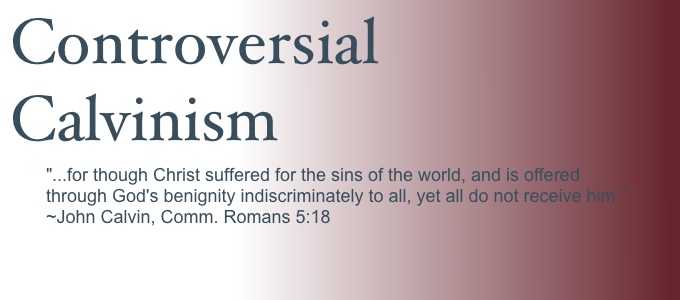
John Calvin on Romans 5:18

This is one of my favorite quotes from Calvin's universalist statements. This is from John Calvin's Commentary on Romans 5:18 (the link goes to one of my previous blog posts where one can read the quote in a larger context and get more of my thoughts on the subject):

He makes this favor common to all, because it is propounded to all, and not because it is in reality extended to all; for though Christ suffered for the sins of the whole world, and is offered through God’s benignity indiscriminately to all, yet all do not receive him.

Justification is "propounded" (i.e., offered or set forth) to all, but not in reality "extended" to all. That is, all men are offered justification, but not all men are actually justified. That's Calvin's meaning here.

Calvin explains that this is so "for though Christ suffered for the sins of the whole world...." No question about the meaning of that, is there? It's not out of context, and it isn't denied by anything in the quote itself. Calvin is asserting this: "Christ suffered for the sins of the whole world...."

Notice the parallelism between Christ's suffering for all on the one hand and the indiscriminate offer to all on the other hand. The "all" here must be really "all," because the suffering is for "the whole world" and the offer is "indiscriminately to all." The ideas explain and reinforce one another. And it isn't "the world of the elect," because some of those for whom Christ died and to whom he is offered, "do not receive him."

It couldn't be clearer.

Table of Contents to Controversial Calvinism

This is a Table of Contents page. Here you will find a full chronological listing (from oldest to newest) of the articles posted on this blog. I will try to keep it current enough to cover everything that isn't listed in the archive section of the blog home page.

Complete Table of Contents

Monday, September 29, 2008

John Calvin on 1John 2:2 - Kendall's "Out Of Context" Quotation

Back to my defense of R. T. Kendall

It is time to return to my critique of Roger Nicole’s criticism of R. T. Kendall. For the sake of reference, one may find Nicole’s critique at this link: John Calvin's View of the Extent of the Atonement. (The essay was originally published in Westminster Theological Journal 47 (1985) 197-225.)

Having made arguments from logic (which I have answered in previous posts) Nicole now takes aim at Kendall’s use of material from Calvin:

Kendall devotes two pages to discussing Calvin’s view of the extent of the atonement. Here he quotes largely the same passages of Calvin we have encountered earlier, [footnote 35] one of which is so wrested from its context as to appear to have a meaning opposite to that which Calvin explicitly delineated.” [footnote 36]

WTJ 47, at page 205. First, as to the question what Calvin said on the subject of the universality of the atonement, I trust that the material available at Calvin and Calvinism has put that question beyond controversy. At this point, only an academic would continue to insist that Calvin taught limited atonement.

As to Nicole’s allegation that Kendall “so wrested” a quote from Calvin “from its context” as to make it mean the opposite of Calvin’s explicit intent, I propose to examine that briefly.

The dispute involves this sentence from Calvin’s Concerning the Eternal Predestination of God,, 148: “It is also a fact, without controversy, that Christ came to atone for the sins of the whole world.” Kendall cites this sentence as evidence of Calvin’s universalism. Nicole, on the other hand, criticizes Kendall, as “wresting” the quote from its context. Here’s Nicole’s footnote:

Calvin, Concerning the Eternal Predestination of God, 148. This passage refutes Georgius’ interpretation of 1 John 2:2. “John does indeed extend the benefits of the atonement of Christ, which was completed by His death, to all the elect of God throughout what climes of the world soever they may be scattered. But though the case be so, it by no means alters the fact that the reprobate are mingled with the elect in the world. It is also a fact, without controversy, that Christ came to atone for the sins of the whole world. But the solution of all difficulty is immediately at hand in the truth and fact that it is whosoever believeth in Him that shall not perish, but shall have eternal life. For our present question is, not what the power or virtue of Christ is, nor what efficacy it has in itself, but who those are to whom He gives Himself to be enjoyed. Now if the possession of Christ stands in faith, and if faith flows from the spirit of adoption, it follows that he alone is numbered of God among His children who is designed of God to be a partaker of Christ. Indeed, the evangelist John sets forth the office of Christ to be none other than that of gathering together all the children of God in one by His death. From all which we conclude that although reconciliation is offered unto all men through HIm, yet, that the great benefit belongs peculiarly to the elect, that they might be gathered together and be made together partakers of eternal life.” Calvin’s Calvinism 165-66 (OC 8.336). By quoting only the sentence in italics, Kendall violated Calvin’s intent.

“Out of context”?

The “out of context” allegation occurs routinely in debate. But having made the allegation, Nicole is obligated to follow up with something to prove the point. Nicole completely fails.

Nicole does provide a section of Calvin’s context; but what does it show? There is nothing in the context to mitigate the force of Calvin’s statement. And Nicole doesn’t provide any argument ... just the quote from Calvin.

In fact, the quote from Calvin clearly substantiates Kendall’s view of the matter. It is perfectly clear that Calvin did in fact believe that Christ had died for the sins of the whole world, in part because he goes to some length to explain how this could be. His explanation provides a solution to that “difficulty.” And having attempted a solution, it shows that he really believed the statement that creates the difficulty.

A look at the solution that Calvin provides further proof to support Kendall. Calvin says that though Christ has died for the whole world, not all believe in him and it is they alone who shall have eternal life. The question, says Calvin, is not the power or efficacy of Christ’s work in and of itself, but the application of the “great benefit” of the atonement, which “belongs peculiarly to the elect.” Calvin distinguished between the intrinsic value of Christ’s work and those who should benefit from it.

This, of course, is exactly what most four-point Calvinists would say: Christ died for all, but only the elect enjoy the benefits of Christ’s work.

Universal intent v. particular intent

This analysis of the situation does not do full justice to either the problem or Calvin’s treatment of it. The question -- this often comes up as one of the preliminary issues in the discussion of limited atonement -- is not the value of Christ’s atonement considered in itself (cf. Calvin’s statement of the “present question” in the quote above). The question is, rather, what is the intent of God in the sacrifice of Christ. The limitation, it is held, is in the intention, not in the value of Christ’s work.

Yes. But the distinction between intrinsic value and intent does not touch the critical distinction some of us would make. Specifically we would point to a distinction between God’s universal intention on the one hand and God’s particular intention on the other. Calvin speaks to this:

From all which we conclude that although reconciliation is offered unto all men through Him, yet, that the great benefit belongs peculiarly to the elect, that they might be gathered together and be made together partakers of eternal life.

Calvin, supra.

Notice the universal intent -- reconciliation “offered unto all men” -- contrasted with the particular intent -- the great benefit which “belongs peculiarly to the elect.” If one would understand Calvin’s universalism, one must at least understand and acknowledge this diverging of divine intentions for the expiation.

Thursday, July 17, 2008

God's promise as grounds for assurance

I was reading the other day in Chronicles ... really ... and I noticed a verse in a new light.

For thou, O my God, hast told thy servant that thou wilt build him an house: therefore thy servant hath found in his heart to pray before thee.

I Chronicles 17:25. Now compare this to Calvin's statement about faith.

For it were of no avail to us to know that God is true, did He not in mercy allure us to himself; nor could we of ourselves embrace his mercy did not He expressly offer it. “I have declared thy faithfulness and thy salvation: I have not concealed thy loving-kindness and thy truth. Withhold not thy tender mercies from me, O Lord: let thy loving-kindness and thy truth continually preserve me” (Psa_40:10,Psa_40:11).

Institutes 3.2.7. Calvin says that knowledge of God would avail us nothing did we not know of the merciful promises of God. David expresses a similar sentiment. Because God had promised him a house, he found the fortitude to ask God for His blessings. Calvin goes on to say:

It were presumptuous in us to hold that God is propitious to us, had we not his own testimony, and did he not prevent us by his invitation, which leaves no doubt or uncertainty as to his will.

The revelation of God's merciful intentions toward us is the grounds on which we can have hope.

Thursday, July 03, 2008

Nicole v. Kendall - Is Universal Atonement Sufficient for Assurance?

I am returning to a critique of Nicole’s arguments against R. T. Kendall’s thesis regarding Calvin. Kendall has said that Calvin’s theology saw assurance as of the essence of saving faith. And Kendall argues that since assurance is of the essence of saving faith, Calvin must have believed in some form of universal atonement. One can only have assurance of God’s interest in him if God has evidenced that interest in some way. For Calvin and for Kendall, the supreme evidence of God’s interest in the individual sinner is Christ’s work on the cross.

Nicole, of course, rejects the notion:

The close connection posited by Kendall between universal atonement and the assurance of faith must also be challenged, for universal atonement is neither necessary nor sufficient for assurance. It is not necessary since my understanding of how the work of Christ affects others is not essential for a perception of how it affects me. It is not sufficient since on Kendall’s showing, all covered by the atonement will not be saved; assurance, if it is to be reliable, needs to be grounded in something that actually makes a difference between the saved and the lost.

Nicole, John Calvin's View of the Extent of the Atonement, Westminster Theological Journal 47 (1985) 197 at 204-205.

We have already examined the question of the necessity of universal atonement for assurance; now we turn to the question of the sufficiency of universal atonement for assurance.

A recent comment by Sean Gerety actually makes the same argument that Nicole has made, i.e., that one can have assurance of salvation only if Christ’s atonement actually saves all those for whom it is made. Nicole says that an atonement worth trusting must “actually [make] a difference between the saved and the lost.” Gerety says that if anyone for whom atonement is made actually suffers in hell, then their sins remain unatoned for and this makes “the promise of salvation in Christ somewhat dubious.”

As Tony has pointed out in that same comment thread, Gerety has not clarified his meaning for the word “atonement.” Charles Hodge complained of this lack of clarity in the common use of the word:

While the verb to atone thus means to expiate and to reconcile by expiation, the substantive means, either the reconciliation itself, or the means by which it is effected. This latter sense is not a Scriptural usage of the word, but is very common in theological writings. Thus when we speak of the atonement of Christ, of its necessity, efficacy, application, or extent, we mean Christ’s work, what He did to expiate the sins of men. This ambiguity of the word necessarily gives rise to more or less confusion.

Hodge, Systematic Theology, Vol. ii., 469. When Gerety refers to atonement, he refers (apparently) generally to Christ’s work, its application, and its effects, lumping these concepts together as if they need not be distinguished. But when I speak of a universal atonement, I do not refer to the application of the benefits of the atonement to the elect, nor do I speak of the actual reconciliation that takes place when men believe the gospel. When I speak of universal atonement, I refer to Christ’s work, i.e., his expiation of the sins of mankind, but not of the application of the atonement or its benefits to a particular individual, and not of the reconciliation that follows faith in Christ.

Nicole’s argument is less ambiguous, though perhaps more problematic for its clarity. Nicole said of the relationship of universal atonement to assurance:

It is not sufficient since on Kendall’s showing, all covered by the atonement will not be saved; assurance, if it is to be reliable, needs to be grounded in something that actually makes a difference between the saved and the lost.

When Nicole speaks of assurance, he means assurance of salvation, whereas Calvin spoke of assurance of God’s love. Thus for Calvin, assurance is logically prior to faith, while for Nicole, faith is logically prior to assurance.

If, like Nicole, we think of assurance as assurance of salvation, then according to Nicole’s scheme, we can be assured of salvation only if the atonement saves all for whom Christ suffered. But why must this be so? It makes as much sense to say that the atonement must save all to whom it is offered as to say that it must save all for whom Christ suffered. There does not appear to be a necessary logical connection between a limitation in the extent of the atonement and the consequent assurance of the trusting sinner. The limitation, if anything, presents obstacles to assurance.

The argument that Nicole is making really amounts to this: a universal atonement is not sufficient to inspire confidence because it doesn’t work for some people. But we must keep in mind that the salvation offered in Christ is rejected or neglected by those who remain unsaved. Their refusal to believe does not make God’s promise or Christ’s work less trustworthy. Does the refusal of the drowning man to embrace the life-preserver make it unworthy of trust for the drowning woman?

As I said in my reply to Gerety, the idea that God will not keep his promise to save all who embrace Christ or that God will not see Christ’s work as sufficient for the trusting sinner is really a species of unbelief. This unbelief is not excused on the grounds that God has shown himself merciful to all.

Friday, April 04, 2008

Does assurance of salvation come from self-examination? Conclusion

This is the conclusion of the previous blog post on the necessity of universal atonement to assurance of salvation. I offer this post with a certain amount of fear and trepidation. I feel certain of my ground in the reading of Calvin, but I stand open to correction on the radical implications this could have for the doctrine of faith. If Kendall is right (and I am inclined to think he is), Calvin's doctrine of faith has been seriously mauled by subsequent developments in protestant Christianity. I offer this for your consideration, but I urge a degree of caution in reading. Take what I say here with a grain of salt as it applies to the Christian doctrine of faith.

Is it possible to know one is saved? That is the question that all Christians desire to know the answer to. For Calvin, certainty was not only possible, it is the essence of saving faith. For Calvin, doubt is a species of unbelief. This is because faith does not look to self, but to Christ alone.

First, we should see that for Calvin, we see certainty of our salvation — of our election — only in Christ Jesus.

But if we are elected in him, we cannot find the certainty of our election in ourselves; and not even in God the Father, if we look at him apart from the Son. Christ, then, is the mirror in which we ought, and in which, without deception, we may contemplate our election. For since it is into his body that the Father has decreed to ingraft those whom from eternity he wished to be his, that he may regard as sons all whom he acknowledges to be his members, if we are in communion with Christ, we have proof sufficiently clear and strong that we are written in the Book of Life. Moreover, he admitted us to sure communion with himself, when, by the preaching of the gospel, he declared that he was given us by the Father, to be ours with all his blessings (Rom_8:32). We are said to be clothed with him, to be one with him, that we may live, because he himself lives. The doctrine is often repeated, “God so loved the world, that he gave his only begotten Son, that whosoever believeth in him should not perish, but have everlasting life (Joh_3:16). He who believes in him is said to have passed from death unto life (Joh_5:24). In this sense he calls himself the bread of life, of which if a man eat, he shall never die (Joh_6:35). He, I say, was our witness, that all by whom he is received in faith will be regarded by our heavenly Father as sons. If we long for more than to be regarded as sons of God and heirs, we must ascend above Christ. But if this is our final goal, how infatuated is it to seek out of him what we have already obtained in him, and can only find in him?

Institutes 3.24.5. Christ is the "mirror" in which we may, without deception, "contemplate our election." Can we contemplate our election by looking to ourselves? No. Thus, for Calvin, assurance could never be gained by self-examination.

Were we to look to ourselves for certainty of our salvation, we could have no certainty at all. In fact, one would see only damnation. Here Calvin disputes with "certain semi-papists" who would say that the Christian can have no certainty of his election, compounding a "mixture of faith and unbelief."

They tell you, if you look to Christ salvation is certain; if you return to yourself damnation is certain. Therefore, your mind must be alternately ruled by diffidence and hope; as if we were to imagine Christ standing at a distance, and not rather dwelling in us. We expect salvation from him - not because he stands aloof from us, but because ingrafting us into his body he not only makes us partakers of all his benefits, but also of himself. Therefore, I thus retort the argument, If you look to yourself damnation is certain: but since Christ has been communicated to you with all his benefits, so that all which is his is made yours, you become a member of him, and hence one with him. His righteousness covers your sins - his salvation extinguishes your condemnation; he interposes with his worthiness, and so prevents your unworthiness from coming into the view of God. Thus it truly is. It will never do to separate Christ from us, nor us from him; but we must, with both hands, keep firm hold of that alliance by which he has riveted us to himself.

Institutes 3.2.24. And if one thinks about it, how could it be otherwise? When we are yet unjustified, can we come to Christ looking to our own works for some assurance of God's favor? Certainly not. And by the same token, how could we have assurance by looking at our works after salvation? Because our works are better?

But as the fruits of regeneration furnish them with a proof of the Holy Spirit dwelling in them, experiencing God to be a Father in a matter of so much moment, they are strengthened in no slight degree to wait for his assistance in all their necessities. Even this they could not do, had they not previously perceived that the goodness of God is sealed to them by nothing but the certainty of the promise. Should they begin to estimate it by their good works, nothing will be weaker or more uncertain; works, when estimated by themselves, no less proving the divine displeasure by their imperfection, than his good-will by their incipient purity. In short, while proclaiming the mercies of the Lord, they never lose sight of his free favor, with all its “breadth and length, and depth and height,” testified by Paul (Eph_3:18); as if he had said, Whithersoever the believer turns, however loftily he climbs, however far and wide his thoughts extend, he must not go farther than the love of Christ, but must be wholly occupied in meditating upon it, as including in itself all dimensions.

Institutes 3.14.19. We are, to be sure, strengthened by the "fruits of regeneration," but only because they furnish proof of "the Holy Spirit dwelling in them," and "experiencing God to be a Father," not contemplating the good works in themselves, or commending our consciences before God by virtue of our good works. The grounds of assurance, for Calvin, must always be found in the favor of God given to us by his free promise of salvation in Christ. Works may confirm our faith, but only because and insofar as they assure us of God's free favor. Were we to contemplate the works by themselves or in themselves, they would surely rob us of all assurance.

But what of the scriptures that speak of gaining assurance by self-examination? R. T. Kendall addresses this question.

The later distinction between faith and assurance seems never to have entered Calvin's mind. Assurance to Calvin comes by what would later be called the direct act of faith.

* * *

What Calvin does not do, then, is to urge men to make their calling and election sure to themselves. He thinks Christ's death is a sufficient pledge and merely seeing Him is assuring. Never does he employ 2 Peter 1:10 in connection with seeking assurance of salvation. He regards 2 Peter generally as an encouragement "to make proof" of one's calling "by godly living" and 2 Peter 1:10 particularly as an argument that our election is to be "confirmed" by a good conscience and an upright life". It should be noted moreover that Calvin does not link this verse to the conscience in terms of deducing assurance of salvation.

"This assurance of which Peter speaks should not, in my opinion, be referred to conscience, as though the faithful acknowledged themselves before God to be elect and called. I take it simply of the fact itself, that calling is shown to be confirmed by a holy life."

R. T. Kendall, Calvin and English Calvinism to 1649, p. 25, citing Calvin, Comm. 2 Peter Preface and 2 Peter 1:10, footnotes omitted. It should be noted that the Baker edition of Calvin's Commentary on 2 Peter has for the above quote, "At the same time, this certainty, mentioned by Peter, ought, I think, to be referred to the conscience...," which is 180 degrees wrong. The Latin confirms the Torrence edition's translation.

Would we have assurance of salvation? For Calvin, Christ alone is "is the mirror in which we ought, and in which, without deception, we may contemplate our election."

Monday, March 31, 2008

Does assurance of salvation come from self-examination?

Many in the reformed camp would have us know of our election from the process of self-examination. For example, Roger Nicole said:

universal atonement is neither necessary nor sufficient for assurance. It is not necessary since my understanding of how the work of Christ affects others is not essential for a perception of how it affects me.

The difficulty is, of course, that any sensible person who contemplates his life with any degree of honesty will find his mind filled with doubt as to the possibility of his salvation. The problem is exacerbated by the thought, "I may be deceiving myself as to my faith in Christ." John MacArthur made much of this possibility of self-deception in a recent series of broadcast sermons. The possibility of self-deception is deeply embedded in our confessions:

Although hypocrites and other unregenerate men may vainly deceive themselves with false hopes and carnal presumptions of being in the favor of God, and estate of salvation (which hope of theirs shall perish): yet such as truly believe in the Lord Jesus, and love him in sincerity, endeavoring to walk in all good conscience before him, may, in this life, be certainly assured that they are in the state of grace, and may rejoice in the hope of the glory of God, which hope shall never make them ashamed.

Westminster Confession of Faith XVIII. 1.

How can I know that I'm not deceiving myself? Am I truly one of the elect? I examine my works, and though I may find reasons for hope, these reasons for hope are ... what? ... my own good works. Surely my good works are no grounds for hope of eternal salvation! And are not my good works (even the best of them) tainted with sin?

Some get over this problem of uneven performance of good works by pointing to a general tenor or course of progress in one's sanctification. Well, yes, but is my progress good enough? Am I self-deceived about my progress in sanctification or the general tenor of my life?

Can I know that I am elect?

R. T. Kendall points out that this problem dominates the reformed doctrine of faith. We who call ourselves reformed have that question constantly nagging at the back of our mind. That these questions do arise in our hearts, every Christian knows. Kendall cites the example of Mrs. Joan Drake, the wife of Sir Francis Drake.

In addition to having a series of maladies including "migraine, perpetual heartburn, and insomnia", Mrs. Drake became "melancholy, distempered, and erratic" and confided that she was not happily married. Mr. Drake was solicitous for her well-being but was unable to ameliorate her emotional state. Mrs. Drake had become convinced that her maladies were owing to her having committed the unpardonable sin and that she was among the number of the reprobate, incapable of changing her appointed state.

Over the next few years (c. 1620-5) several eminent divines were called in to help Mrs. Drake. The first was John Dod, "the fittest man known" to help her. When Dod arrived "she suddenly flung upstaires" and "shut her selfe in". She came out only after Mr. Drake threatened "to beat down the door". But Dod's prayers and counsel — which lasted a month — did not avail. He returned several times in the ensuing months, but Mrs. Drake remained convinced "shee was a damned Reprobate, must needs goe unto Hell to live for ever", that it was "in vaine, and too late for her to use any meanes" She wished Mr. Dod "to let her alone", for "the Decree of her rejection and damnation" was "past irrevocable"....

R. T. Kendall, Calvin and English Calvinism to 1649, 126-127, citing George H. Williams, "Called by Thy Name, Leave us Not: The Case of Mrs. Joan Drake," Harvard Library Bulletin (1968).

The case of Mrs. Drake is certainly an extreme one (or so we would tell ourselves) and she did eventually come to assurance of faith; but every Christian (especially Calvinists) who reads this will identify to at least a small degree with the doubts of Mrs. Drake. An honest examination of our good works will generally lead us to doubt our salvation. Some ministers are quite skilled at making Christians doubt their faith by calling on them to examine their works.

I'll conclude this tomorrow with the answer from Calvin.

Wednesday, March 12, 2008

God's favor toward sinners - Calvin on Psalm 51:7

I was reading today in Calvin's commentary on Psalm 51:7 and found some words that strongly reminded me of Calvin's commentary on John 3:16. There Calvin says that "our minds cannot find calm repose, until we arrive at the unmerited love of God." Here's the quote from Calvin's comment on the Psalm:

The truth is, that we cannot properly pray for the pardon of sin until we have come to a persuasion that God will be reconciled to us. Who can venture to open his mouth in God’s presence unless he be assured of his fatherly favor? And pardon being the first thing we should pray for, it is plain that there is no inconsistency in having a persuasion of the grace of God, and yet proceeding to supplicate his forgiveness.

John Calvin, Comment. Psalm 51:7.

This idea that faith sees God as propitious toward us — as pacified, as an indulgent father — is a strong one in Calvin's theology; it runs like a vein of silver through his teaching. You find it cropping up everywhere.

The liberals, perhaps, overemphasized the fatherly love of God to the exclusion of faith in Christ, but some modern evangelicals may have improperly downplayed the fatherly love of God in reaction to the liberals. Calvin is calling me back.

Sunday, March 09, 2008

Is Universal Atonement Necessary for Assurance?

I continue my critique of Roger Nicole's answer to R. T. Kendall's important work on Calvin's doctrine of faith. You can look at previous blog entries in this series to gain some context:

Kendall held that Calvin could not have taught limited atonement because of the strong connection that Calvin saw between the atonement as a testimony of God's love, and the corresponding assurance men can have of God's love. Indeed, for Calvin, this objective assurance of God's love is the essence of faith as well as the grounds of subjective assurance of forgiveness of sins.

Roger Nicole challenged Kendall's idea, asserting that there is no strong connection between universal atonement and assurance of salvation.

The close connection posited by Kendall between universal atonement and the assurance of faith must also be challenged, for universal atonement is neither necessary nor sufficient for assurance. It is not necessary since my understanding of how the work of Christ affects others is not essential for a perception of how it affects me. It is not sufficient since on Kendall’s showing, all covered by the atonement will not be saved; assurance, if it is to be reliable, needs to be grounded in something that actually makes a difference between the saved and the lost.

Nicole, John Calvin's View of the Extent of the Atonement, Westminster Theological Journal 47 (1985) 197 at 204-205.

We have already seen in previous blog entries that Calvin did believe, as Kendall pointed out, that the sending of Christ as the atonement for sins was the highest testimony of God's love for man. Thus whether Nicole's argument objecting to the connection between atonement and assurance is valid, Calvin evidently believed the connection and Kendall was right to point it out.

But I wish now to move to a consideration of the logic of Nicole's argument.

Is universal atonement necessary for assurance?

First we need to make sure we understand what assurance refers to. For Calvin, assurance is assurance of God's love, not assurance of one's own salvation.

We shall now have a full definition of faith, if we say that it is a firm and sure knowledge of the divine favor toward us, founded on the truth of a free promise in Christ, and revealed to our minds, and sealed on our hearts, by the Holy Spirit.

Institutes, 3.2.7

Consider that statement again. Faith is firm and sure knowledge of the divine favor toward us. For Calvin, this assurance of divine favor is of the essence of faith. And this assurance of divine favor comes from the testimony of God himself.

It were presumptuous in us to hold that God is propitious to us, had we not his own testimony, and did he not prevent us by his invitation, which leaves no doubt or uncertainty as to his will. It has already been seen that Christ is the only pledge of love....

ibid. Thus God has given us his assurance of his love for us, the testimony being Christ himself, and this testimony is the foundation for our faith.

Nicole's argument on assurance

Nicole says that universal atonement is not necessary to assurance:

It is not necessary since my understanding of how the work of Christ affects others is not essential for a perception of how it affects me.

Thus, Nicole would have us look to how the work of Christ has affected me before I can have assurance. Notice that this is a different logical order from Calvin. Calvin has assurance of God's love logically prior (in order of causation) to faith, and Nicole has faith (i.e., Christ's work has affected me ... presumably in regeneration and sanctification) prior to assurance. This ought to give us a clue that Nicole is speaking of a different assurance than Calvin. Calvin is speaking of the certainty of God's interest in me, whereas Nicole is speaking of the certainty of my interest in God. We could object to Nicole's argument at this point as being irrelevant to Calvin's and Kendall's thesis. He's simply not on the same page.

But let's assume that the difference in senses of assurance that Calvin and Nicole is merely semantic. There is a more important objection here, and that is that Nicole would drive us inward to seek assurance. Assurance is possible by knowing how Christ's work has affected me. Some theologians speak of the practical syllogism, which might look something like this:

Major Premise: Only true believers manifest the fruits of sanctification.
Minor Premise:I see the fruits of sanctification in my life.
Conclusion: Therefore, I may be assured that I have a saving faith.

Do you see how in this way of looking at things, assurance comes from looking at oneself? In Calvin's way, assurance comes not from looking at oneself, but from looking at Christ. The difference here is referred to as the difference between assurance based on a direct act of faith or assurance based on a reflex act of faith. The direct act of faith looks directly to Christ, the reflex act of faith looks to the fruits of salvation in oneself.

Calvin taught that we cannot look to ourselves for assurance.

For there is no where such a fear of God as can give full security, and the saints are always conscious that any integrity which they may possess is mingled with many remains of the flesh. But as the fruits of regeneration furnish them with a proof of the Holy Spirit dwelling in them, experiencing God to be a Father in a matter of so much moment, they are strengthened in no slight degree to wait for his assistance in all their necessities. Even this they could not do, had they not previously perceived that the goodness of God is sealed to them by nothing but the certainty of the promise. Should they begin to estimate it by their good works, nothing will be weaker or more uncertain; works, when estimated by themselves, no less proving the divine displeasure by their imperfection, than his good-will by their incipient purity. In short, while proclaiming the mercies of the Lord, they never lose sight of his free favor, with all its “breadth and length, and depth and height"....

Institutes 3.14.19. If we had no objective assurance of God's universal love for men, we would have no other place to look than to our own sanctification. Nicole would have us look there for assurance, while Calvin says "nothing will be weaker or more uncertain."

The problem, of course, is that if Christ did not die for some men — if for some men Christ's death promises nothing — then how am I to know of the divine favor? Since Christ's death is the highest testimony of God's love, then if that testimony is diminished by the possibility that it is not for me, then I am deprived of the highest objective assurance of that love. I am indeed left to examine my own works for assurance.

Calvin would not have us look to ourselves, but to Christ. As Calvin admits in 3.2.24, "If you look to yourself damnation is certain...."

How might we feel the certainty of our salvation? Not in ourselves, but only in Christ:

But if we are elected in him, we cannot find the certainty of our election in ourselves; and not even in God the Father, if we look at him apart from the Son. Christ, then, is the mirror in which we ought, and in which, without deception, we may contemplate our election.

Institutes 3.24.5