Showing posts with label About me. Show all posts

Thursday, October 05, 2006

My Agenda

Yes, I have an agenda, and I want you to know it before we go any farther. Here, in bold print, is my agenda. I want my readers to accept that a 5-point Calvinist can say the following things:

God loves all men.
God desires the salvation of all men and offers salvation to all by faith in Christ.
Christ died for all men; he died for you.

The last item on the agenda is particularly important to me as it affects the way I describe Christ’s work to others. Though I am not and have never been the pastor of a church, I have had many opportunities to preach in churches over the past 20 years. Until a couple of years ago, I was perplexed about what to say when preaching the gospel. What do I say about the death of Christ? Do I say nothing? Absurd! Do I say “Christ died for you” if I think that he might not have? Again absurd. Do I say “he died for sinners” when my audience might properly draw the conclusion that since they are sinners, Christ died for them?  Absurd — and dishonest (I make no accusation here — I speak only for myself) if I really am trying to hide from the consequences of belief that Christ did not really die for many in my audience.

To present the gospel freely, I believe we must be able to say "Christ died for you, and if you believe on him, you will be saved." The freedom to say exactly that is a great relief.  And it is perfectly in keeping with historic Calvinism.

That’s basically it.  There are some additional items that might qualify as pet peeves but are only tangentially related to the main topic.  I’ll squeeze them in anyway.  My main pet peeve — which I will address early and often — is the matter of the power of prayer.  Prayer does change things, and I can prove it from the Bible.

So there you go.  That’s the goal, the road map, the telos.  Have fun!

Technorati Tags: , , , , , , , , , , ,

Tuesday, October 03, 2006

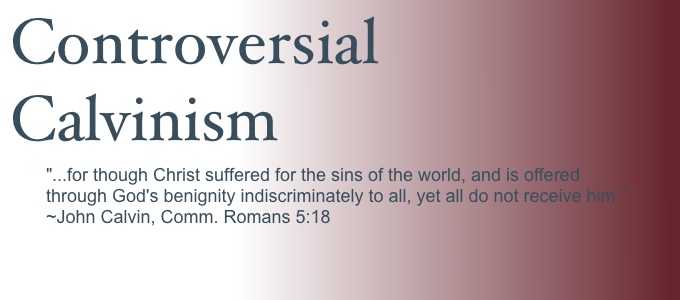
Controversial Calvinism

Calvinism is controversial. Further, the view that I will espouse in this blog will be controversial with many Calvinists. It is primarily those folks I wish to address. Calvinism as it is held in many conservative churches and denominations, is destructive of true doctrine and the Christian faith to a greater or lesser degree. I shall point out the deficiencies (as I perceive them) along the way.

I am a conservative evangelical, and hold to all the doctrines that label implies. I am a Baptist. I also call myself a Calvinist; that is, I hold to the doctrines of grace, as they are called: TULIP — Total depravity, Unconditional election, Limited atonement, Irresistible grace, and Perseverance of the saints. I must make an important qualification: I hold to the doctrine of limited atonement as it is defined by R. L. Dabney; I also hold to the doctrine of unlimited atonement as defined by W. G. T. Shedd. The first sign of life in the Calvinist mind is a willingness to grapple with the distinction made by these great American theologians of the 19th century between the work of Christ on behalf of the world and the application of that work to the individual believer. These men used different definitions for their terms and drew somewhat different conclusions. Wrestling with those definitions and distinctions will bring about a blessing, though one may be permanently afflicted with a limp. Much more on that to come in this space.

How would one label my position? The critic will be tempted to reach for the term “Amyraldian”; the difficulty with that label is that Amyraut’s work is not widely known, but his position has been vaguely equated with “four-point” Calvinism. I don’t know Amyraut’s position well enough to affirm or rebut this, but I doubt it is accurate. I am identifying more closely with Calvin, Shedd, Dabney, and Charles Hodge — would the critic call them Amyraldian?

How about “moderate Calvinism”? Certain authors, who shall remain nameless, have so abused that term as to make it useless. I oppose high Calvinism as held by many Presbyterian and Reformed Baptist theologians. I more strongly oppose the hyper-Calvinism of the Primitive Baptists and the PRC — as well as anything that has the whiff of hyper-Calvinism in it; unfortunately, much that is considered normal Calvinism these days has that malodorous essence. So I guess we’ll go with “historic Calvinism.” I hope to be able to explain and justify that label.

Enough for a brief introduction. We shall take up the cudgels tomorrow. I leave you with a quotation from John Calvin’s commentary on 2 Peter 3:9:

So wonderful is his love towards mankind, that he would have them all to be saved, and is of his own self prepared to bestow salvation on the lost.