Saturday, June 30, 2007

Christ bore the sin of many — or of all?

The reformed view of "the sin of many."

That wording, "the sin of many" can be found in Isaiah 53:12:

Therefore will I divide him a portion with the great, and he shall divide the spoil with the strong; because he hath poured out his soul unto death: and he was numbered with the transgressors; and he bare the sin of many, and made intercession for the transgressors.

Often the defender of Calvinistic soteriology will point to this verse and others like it, and say, "See? Christ bore the sins of many, not of all." "Many is not all," they will say. The "many" for the reformed theologian is often equivalent to "the elect," or "his people," or other such constructions. The Puritan theologian John Flavel interpreted the "many" of Isaiah 53:12 as "the elect." I take the following quotation from his sermon on the covenant of redemption. Flavel says:

In this verse we have, 1. His work. * * * His work, which was indeed a hard work, to pour out his soul unto death, aggravated by the companions, with whom, being numbered with transgressors; the capacity in which, bearing all the sins of the elect, "he bare the sins of many"....

So Flavel equates bearing the sins of many with bearing the sins of the elect. About what we'd expect.

For Calvin, many sometimes means all

But John Calvin does not do what Flavel and the rest of the reformed community has done. Quite to the contrary, Calvin here equates bearing the sins of many with bearing the sins of all. My friend David has used a portion of Calvin's comment on this verse for his signature line in his emails:

I approve of the ordinary reading, that he alone bore the punishment of many, because on him was laid the guilt of the whole world. It is evident from other passages, and especially from the fifth chapter of the Epistle to the Romans, that "many" sometimes denotes "all."

The irony of this is piquant. Whereas most who call themselves Calvinists often read "all" as "many," Calvin, in this important verse, reads "many" as "all".

Odd hermeneutical rules and how to stop them

But there is a way out for the Calvinist. Those who are willing to impose odd hermeneutical rules in their quest to conform Calvin to their own image might say that in reading Calvin, the word "all" must never refer to all individual men; it must always refer to "all classes of men." "All" means "all men generally," by which they mean "all kinds" or "all sorts" — by which they mean some of all kinds or sorts — by which they mean not all. ( It is that easy to turn a positive statement into a negative one. It just requires the will to believe.)

It would certainly be an odd exegetical rule that universally changes "all" to "not all". But in this case — and this is the main point of this article — we have some assistance from the great man himself.

All means every one

Here is a little additional context for Calvin's quote, taken from his comment to Isaiah 53:12:

I have followed the ordinary interpretation, that "he bore the sin of many," though we might without impropriety consider the Hebrew word [Hebrew omitted - slc] (rabbim,) to denote "Great and Noble." And thus the contrast would be more complete, that Christ, while "he was ranked among transgressors," became surety for every one of the most excellent of the earth, and suffered in the room of those who hold the highest rank in the world. I leave this to the judgment of my readers. Yet I approve of the ordinary reading, that he alone bore the punishment of many, because on him was laid the guilt of the whole world. It is evident from other passages, and especially from the fifth chapter of the Epistle to the Romans, that "many" sometimes denotes "all."

Exclamation point!

Consider what this means for our interpretation of Calvin. In Isaiah 53:12, Calvin says that "many" means "all." And even if the word "many" be translated "great and noble," Calvin says that Christ is surety for every one of them — every one of the great and noble. Thus we have — by a simple, straightforward reading — determined that all in Calvin's comment to Isaiah 53:12 does not mean all classes, or all sorts, or all kinds; it means all individuals.

This has strong implications for our hermeneutics, especially against those who would impose that odd rule referred to above. It also has implications for our reading of Calvin's comment to 1Timothy 2:4, where he admittedly refers the passage to princes and rulers. Princes and rulers, yes — every one of them.

May I say exclamation point again?

Exclamation point!

Tuesday, June 26, 2007

Individuals or Classes? Calvin on 1Timothy 2:4-6

I offer this article as a supplement to the first article critiquing Roger Nicole's article entitled, John Calvin's View of the Extent of the Atonement. (Westminster Theological Journal 47 (1985): 197-225). I wish to address a point about Calvin's comment on 1Timothy 2:4 that may seem to some readers to have been omitted.

Classes of men vs. individuals in 1Timothy 2:4

In his comment to that verse, Calvin said, "God wishes that the gospel should be proclaimed to all without exception." In my previous blog post, I said that Calvin's statement shows his view that God has a universal love for mankind. Though I believe this to be true, there is a problem. In his comment to this verse, Calvin also said the following:

Hence we see the childish folly of those who represent this passage to be opposed to predestination. "If God" say they, "wishes all men indiscriminately to be saved, it is false that some are predestined by his eternal purpose to salvation, and others to perdition." They might have had some ground for saying this, if Paul were speaking here about individual men; although even then we should not have wanted the means of replying to their argument; for, although the will of God ought not to be judged from his secret decrees, when he reveals them to us by outward signs, yet it does not therefore follow that he has not determined with himself what he intends to do as to every individual man.

But I say nothing on that subject, because it has nothing to do with this passage; for the Apostle simply means, that there is no people and no rank in the world that is excluded from salvation; because God wishes that the gospel should be proclaimed to all without exception. Now the preaching of the gospel gives life; and hence he justly concludes that God invites all equally to partake salvation. But the present discourse relates to classes of men, and not to individual persons; for his sole object is, to include in this number princes and foreign nations.

This is certainly problematic for my position. If Calvin is not speaking here of individual men, but only of man as a class (as seems apparent from the quoted paragraphs), then there is no reason to see a universal love of God in this comment. According to this view of things, God may desire all nations (whether Jew or gentile) and all ranks of men (whether peasants or kings, male or female, bond or free) to hear the gospel call; but this may not mean that God desires all individuals to hear the gospel call.

Classes vs. individuals in Calvin's comment to 1Timothy 2:5

The matter becomes even more difficult for my position from a statement Calvin makes in his comment to the following verse:

And one Mediator between God and men This clause is of a similar import with the former; for, as there is one God, the Creator and Father of all, so he says that there is but one Mediator, through whom we have access to the Father; and that this Mediator was given, not only to one nation, or to a small number of persons of some particular rank, but to all; because the fruit of the sacrifice, by which he made atonement for sins, extends to all. More especially because a large portion of the world was at that time alienated from God, he expressly mentions the Mediator, through whom they that were afar off now approach.

The universal term all must always be referred to classes of men, and not to persons; as if he had said, that not only Jews, but Gentiles also, not only persons of humble rank, but princes also, were redeemed by the death of Christ. Since, therefore, he wishes the benefit of his death to be common to all, an insult is offered to him by those who, by their opinion, shut out any person from the hope of salvation.

Regarding these paragraphs from Calvin's comment to 1Timothy 2:5, Nicole says this:

It is not fair to Calvin to separate the last sentence from the remainder of the paragraph and to pretend on that basis that he advocates a universal atonement.

Nicole at 213. Agreed, provided we keep two points in mind. First, one might argue universal atonement from Calvin on other bases and from other passages. Second, though it may be unfair to separate one sentence from another in a paragraph, it would be equally unfair to pretend that the first sentence of this paragraph must govern all of Calvin's work as a sort of hermeneutical rule (viz., the word "all" in Calvin must always refer to all classes of men, never to all individuals. I do not suggest that Nicole has made such a rule).

Calvin often speaks of all the individuals of humanity. The interpretation of universalistic passages of this sort must not be burdened by unreasonable and woodenly applied maxims. Thus though this particular passage may be equivocal because of the presence of the "classes" vs. "individuals" comment, that should not unduly restrict our interpretation of other passages, though we should admit the possibility of such a particularistic interpretation where warranted.

Does God desire that the gospel be proclaimed to all individuals?

The universalistic interpretation of Calvin that I am most concerned with in the 1Timothy 2:4-6 context is this:

... God wishes that the gospel should be proclaimed to all without exception. Now the preaching of the gospel gives life; and hence he justly concludes that God invites all equally to partake salvation.

Calvin, Comment to 1Timothy 2:4. Are we warranted in saying that the gospel call should be given to all individuals indiscriminately, and that thereby God invites all equally to partake of salvation? Does this truly represent a universalistic wish, will, or desire in God as I claimed in my previous essay? On this point Nicole — and I agree with him — says this:

To this we reply in acknowledging readily that Calvin does indeed assert the propriety of, yea, the divine mandate for an indiscriminate call to salvation addressed to any and all human beings that may be reached by language. We furthermore believe that Calvin was right in line with Scripture, and that those who would restrict the call to the elect are mistaken.

Nicole at 213. This suggests a positive answer to our question. It does at least answer the question regarding the divine command: the gospel should be preached to all individuals without exception. I would add that this also means that —for Calvin, at least— God desires for all men to hear the gospel.

Thursday, June 21, 2007

Calvin vs. Cunningham & Nicole

Roger Nicole wrote an article published in the Westminster Theological Journal in 1985 entitled, John Calvin's View of the Extent of the Atonement. Dr. Nicole's article has been published online at A Puritan's Mind, and I thank Dr. McMahon (and Dr. Nicole) for permission to quote from and link to that article.

I plan to critique the article at some length. Calvinists often cite Dr. Nicole as authority for the proposition that Calvin taught limited atonement, when it appears that nothing could be further from the truth. The corpus of Calvin's work abounds with evidence to the contrary. Dr. Nicole's arguments need to be examined and answered. I plan to proceed through Dr. Nicole's article paragraph by paragraph. I won't write about every paragraph, but I will highlight the arguments and attempt to answer them. The material that is purely bibliographic I will generally skip over unless there is a logical argument buried in it. For example, I may answer some of Dr. Nicole's critricisms of Kendall.

Early in the article, Dr. Nicole cites William Cunningham as one of the 19th-century defenders of the Calvin taught limited atonement position, and as perhaps the first to cite the Heshusius tract as proof of that position. (I have answered the alleged proof from Heshusius at some length in previous blog posts.) I begin my critique of Nicole's article with a review of Cunningham's arguments and Nicole's citation of them.

Did Calvin emphatically repudiate a universal saving will in God?

According to Dr. Nicole, Cunningham proved that Calvin did not teach unlimited atonement by two lines of reasoning.

William Cunningham's article, as is usual with this author, is a very solid and searching study. In addition to discussing the important quotation of Calvin noted above, Cunningham reasoned that Calvin's emphatic repudiation of a universal saving will and endorsement of election and reprobation as well as his particularistic interpretation of passages invariably appealed to by hypothetical universalists (1 Tim 2:4; 1 John 2:2) reflect a line of thought in which particular rather than universal redemption finds a fitting place.

Nicole's footnote 15 cites W. Cunningham, "Calvin and Beza," British and Foreign Evangelical Review 10 (1861) 641-702. Reprinted in The Reformers and the Theology of the Reformation (Edinburgh: Clark, 1862) 398-402.

The first line of proof is Calvin's so-called "emphatic repudiation of a universal saving will." It always surprises me to see it alleged that Calvin denied a universal saving will. It is surprising because — as far as I can tell — he never denied it, and often asserted it. Where can this "emphatic repudiation" be found? If Calvin did emphatically repudiate the idea, then either Dr. Nicole or his cited authority should have provided the proof. Alas, neither Nicole nor Cunningham provide any quotations, information, or argument. Here's what Cunningham says on the matter:

That Calvin denied the doctrine of God's universal grace or love to all men, as implying some desire or intention of saving them all, and some provision directed to that object, is too evident to any one who has read his writings, to admit of doubt or to require proof.

* * *

[T]he fact of Calvin so explicitly denying the doctrine of God's universal grace or love to all men, affords a more direct and certain ground for the inference, that he did not hold the doctrine of universal atonement....

Cunningham, Reformers, 398, 399. Cunningham's fallacy is petitio principii, or simply begging the question. It was Cunningham's duty to provide evidence of his contention, but he failed — refused — to provide it. What is so ironic about Cunningham's evasion is that he himself unwittingly provides proof to the contrary not two pages later in his article, where he quotes Calvin's view on 1Timothy 2:4. Here it is, in the Latin Cunningham used:

Apostolus simpliciter intelligit nullum mundi vel populum vel ordinem a salute excludi, quia omnibus sine exceptione evangelium proponi Deus velit.

Cunningham, 400. Or, in English, "the Apostle simply means, that there is no people and no rank in the world that is excluded from salvation; because God wishes that the gospel should be proclaimed to all without exception." Omnibus sine exceptionie — "all without exception." Is this not precisely the universalistic wish — "desire or intention" — that Cunningham denied is present in Calvin's thought? In fact, it is very easy to find God's universal love or grace taught in Calvin's work. Cunningham's failure to bring forward some solid evidence to the contrary is not surprising.

Nicole cannot escape censure here as well. He ought to have produced evidence of the alleged emphatic denial —even though Cunningham did not — if he thought it existed. The rote and uncritical citation of old authorities can lead to a chain of error that extends as far as human credulity. Authority X says "black is white." Authority Y quotes authority X. Authority Z, who respects Authority Y immensely, quotes him as saying that Authority X has proved "black is white." Before you know it, a whole cult builds up based on the authority of well-respected men.

This sort of thing used to occur frequently in the world of chess. Chess literature abounded with ideas based on authority quoting authority, even though the original writer may have been utterly wrong. The advent of strong chess-playing computer programs, available to any rank amateur for a few dollars, has reduced the incidence of this sort of thing. The merest beginner can fire up his computer and actually check whether the world-renowned authority is correct in his analysis.

A similar phenomenon is occurring in historical theology. The old documents are becoming available to the dummies on the internet. We are checking.

To disprove Nicole's and Cunningham's contention, one need only look to the obvious commentary on John 3:16, where Calvin waxed eloquent on the love of God shown to the whole world in the advent of Christ. I quote only a small part:

And he has employed the universal term whosoever, both to invite all indiscriminately to partake of life, and to cut off every excuse from unbelievers. Such is also the import of the term World, which he formerly used; for though nothing will be found in the world that is worthy of the favor of God, yet he shows himself to be reconciled to the whole world, when he invites all men without exception to the faith of Christ, which is nothing else than an entrance into life.

Calvin, Commentary on John 3:16

Do particularistic interpretations of 1Timothy 2:4 and 1John 2:2 mean that all Calvin's interpretations must be particularistic?

The second argument made by Cunningham and echoed by Nicole is this: Calvin's particularistic interpretations of 1Timothy 2:4 and 1John 2:2 "reflect a line of thought in which particular rather than universal redemption finds a fitting place." (Nicole, at 201.)

On this second argument, Cunningham says the following:

The other consideration to which we referred, as affording some positive evidence, though not direct and explicit, that Calvin did not hold the doctrine of a universal atonement, is this, — that he has interpreted some of the principal texts on which the advocates of that doctrine rest it, in such a way as to deprive them of all capacity of serving the purpose to which its supporters commonly apply them. If this position can be established, it will furnish something more than a presumption, and will almost amount to a proof, that he did not hold the doctrine in question.

The flimsiness of this slip-shod argument is shocking. That Calvin held an interpretation of some passages (Cunningham cites only the two passages and Nicole provides nothing further) that is consistent with limited atonement is no proof whatsoever that Calvin held limited atonement or denied unlimited atonement.

First, it does not prove that Calvin held limited atonement, as Cunningham admits. He says, "Let it be observed, that our object is not to show, that we are warranted in adducing the authority of the great name of Calvin as a positive testimony in favour of the doctrine of particular redemption, — of a limited atonement...." (Cunningham at 400.)

And if Calvin's interpretation of these passages is consistent with limited atonement, it does not prove that his interpretation is inconsistent with unlimited atonement.

In fact, Calvin's interpretation of these passages is quite consistent with and often cited in favor of universalistic aspects of Christ's work. Calvin's comment on 1John 2:2 is often cited to show that Calvin approved of the formula sufficient for all, efficient for the elect. The comment on 1Timothy 2:4 contains the idea that God desires that the gospel be preached to all without exception.

Despite this obvious truth, Cunningham makes the bold claim that Calvin's position on those two passages "will almost amount to a proof, that he did not hold the doctrine in question." Nicole, following Cunningham, says that Calvin's interpretation of these passages "reflect a line of thought in which particular rather than universal redemption finds a place." (One could note the subtle shift of thought. Whereas Cunningham said that this line of reasoning shows that Calvin did not hold unlimited atonement, Nicole says that the line of reasoning reflects particularism rather than universalism — a significantly different idea, logically.)

A final point must be mentioned: if Calvin interpreted the two passages in a way suited to particularistic views, it does not mean that he had an agenda to interpret all such passages in that way. It may mean that for the sake of honesty he interpreted the passages in the way grammar, logic, and context demanded. If this be the case, must it necessarily follow that all such passages will be interpreted in the same way? For Calvin this is obviously not the case.

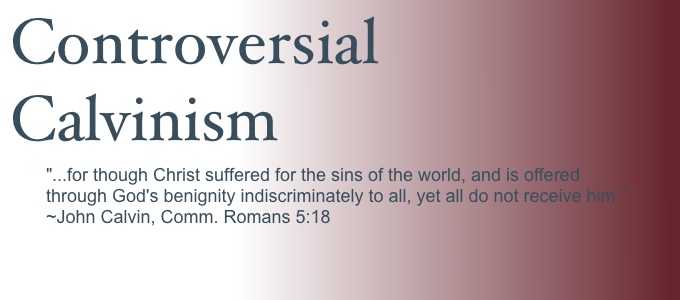
While making these meager connections, neither Cunningham nor Nicole deal with the strongly universalistic statements in Calvin. What of, for example, Calvin's statement in his comment to Romans 5:18?

for though Christ suffered for the sins of the whole world, and is offered through God's benignity indiscriminately to all, yet all do not receive him.

Calvin, Commentary on Romans 5:18

Cunningham's arguments are inadequate to his purpose, and Nicole's citation of Cunningham amounts to nothing more than an appeal to Cunningham's authority.

More to come
Wednesday, June 20, 2007

Roger Nicole on Calvin and Limited Atonement

I have started a series of blog posts critiquing Roger Nicole's article on Calvin's view of the atonement. The article is: Roger Nicole, John Calvin’s View of the Extent of the Atonement, Westminster Theological Journal 47 (1985) 197-225. You can find the article available online at A Puritan’s Mind.

If you wish to see a list of my articles critiquing Nicole, just click on this link.

Friday, June 01, 2007

The Heshusius Tract Proves Calvin Didn't Teach Limited Atonement

My thesis is that Calvin did not teach limited atonement — not the kind advocated by most modern Calvinists at least. This is proved by a reading of Calvin's tract against Heshusius. In previous blog posts, I went through the famous statement from the tract that supposedly proves that Calvin did teach limited atonement. (You know the one — "I should like to know how the wicked can eat the flesh of Christ which was not crucified for them? and how they can drink the blood which was not shed to expiate their sins?") My analysis shows that far from proving the point, Calvin's argument against Heshusius actually proves the opposite (Nicole to the contrary notwithstanding).

I would like to focus on a slightly different aspect of the Heshusius matter. My friends Tony Byrne and David Ponter have made much of the fact that the sincere offer of the gospel must be backed by a universal expiation. If the sin of all men was not borne by Christ on the cross, then the offer of the gospel to them must, of necessity, be empty of meaning.

I wish to consider this question in the setting of Calvin's theology of the Lord's Supper and draw inferences about Calvin's theology of the atonement from his theology of the Lord's Supper. (Another of my friends has alleged that no such inference may properly be made, but we shall see.)

The substantial presence of Christ in the elements

As we saw in examining the Heshusius tract, Calvin believed that Christ is substantially present in the elements of the Eucharist.

[I]t is declared in my writings more than a hundred times, that so far am I from rejecting the term substance, that I ingenuously and readily declare, that by the incomprehensible agency of the Spirit, spiritual life is infused into us from the substance of the flesh of Christ. I also constantly admit that we are substantially fed on the flesh and blood of Christ....

One should note that Calvin says not only that Christ is given to us in the Supper, but that Christ's flesh, his body and blood, is given to us in the Supper. Such is the mystery that Calvin treats of in his doctrine of the Lord's Supper — the substantial, but not material and local, presence of Christ's flesh in the elements.

I do not restrict this union to the divine essence, but affirm that it belongs to the flesh and blood, inasmuch as it was not simply said, My Spirit, but, My flesh is meat indeed; nor was it simply said, My Divinity, but, My blood is drink indeed.

The offer of Christ in the elements

Second, this presence of Christ in the Eucharistic elements is also an offer to believers and unbelievers alike to partake of the benefits of his atonement. I have three quotations from the tract to that effect. Quote number one:

Still [Heshusius] insists, and exclaims that nothing can be clearer than the declaration, that the wicked do not discern the Lord’s body, and that darkness is violently and intentionally thrown on the clearest truth by all who refuse to admit that the body of Christ is taken by the unworthy.

He might have some color for this, if I denied that the body of Christ is given to the unworthy....

Quotation number two:

It is indeed true, that contumely is offered to the flesh of Christ by those who with impious disdain and contempt reject it when it is held forth for food; for we maintain, that in the Supper Christ holds forth his body to reprobates as well as to believers....

And number three:

[I]n [the sacraments] accordingly we obtain possession of Christ, and spiritually receive him with his gifts: nay, he is certainly offered in common to all, to unbelievers as well as to believers.

In the Lord's Supper, Christ is presented as the life-giving sacrifice for sins

The third point in my argument is that according to Calvin, the Supper presents Christ as the lamb slain for our sins. The observance is not merely a memorial or a duty to be performed, but a picture of the gospel and an offer of the benefits of it. Because of the sacrifice that the Supper portrays, the sacrament gives life to all who partake in faith.

In this first quotation, Calvin shows that by partaking, believers are given spiritual life and are substantially fed through the elements. He says:

But it is declared in my writings more than a hundred times, that so far am I from rejecting the term substance, that I ingenuously and readily declare, that by the incomprehensible agency of the Spirit, spiritual life is infused into us from the substance of the flesh of Christ. I also constantly admit that we are substantially fed on the flesh and blood of Christ....

In this next quote, Calvin opposes Heshusius's insistence on the physical presence of Christ's body in the elements:

His [Heshusius's] expression is, that the very substance of the flesh and blood must be taken by the mouth; whereas I define the mode of communication without ambiguity, by saying, that Christ by his boundless and wondrous power unites us into the same life with himself, and not only applies the fruit of his passion to us, but becomes truly ours by communicating his blessings to us, and accordingly conjoins us to himself in the same way in which head and members unite to form one body.

Note carefully in this previous quote that Calvin makes a close connection between the observance of the Eucharist and the application of the benefits of the atonement. According to Calvin, the benefits of Christ's passion are applied through participation in the Supper. The communion observance communicates Christ's life to us. How fearful, then, the consequences of the neglect of or the exclusion from this observance. And is that not the point of church discipline —excommunication — which is named for the exclusion from the Lord's Supper?

Next, let's return to a quote already given above in part. Here Calvin answers Heshusius's charge that Calvin's doctrine fails to take into account that the unworthy are condemned for their failure to discern the Lord's body in the Supper:

He might have some color for this, if I denied that the body of Christ is given to the unworthy; but as they impiously reject what is liberally offered to them, they are deservedly condemned for profane and brutish contempt, inasmuch as they set at nought that victim by which the sins of the world were expiated, and men reconciled to God.

Again take note that in their contempt for the Supper, the wicked set at nought the lamb of God. So close is the connection between Calvin's doctrine of the Lord's Supper and his doctrine of the atonement.

The Supper is not a sham offer

Here I have only one quote from the tract:

In our Agreement it is twice or thrice, distinctly stated, that since the testimonies and seals which the Lord has given us of his grace are true, he, without doubt, inwardly performs that which the sacraments figure to the eye, and in them accordingly we obtain possession of Christ, and spiritually receive him with his gifts....

This idea is not popular in the reformed community in America. It is certainly not popular among the Baptists and apparently not so popular among most Presbyterians. But Calvin plainly taught that the promises of the sacraments are more than merely signs or symbols.

In this article I have limited myself to quotations from the tract against Heshusius, but all of the arguments here could have been sustained from sentiments expressed in the Institutes or Commentaries. The reader might consult Book 4 of the Institutes, chapter 17. Or take a look at Calvin's commentary on 1Corinthians 11.

Limited atonement antithetical to Calvin's doctrine of the Lord's Supper

Let me state this in a somewhat controversial manner, noting that, ironically, I am myself a Baptist. Apart from the Federal Vision sympathizers, most Presbyterians have a Baptist view of the Lord's Supper. This may be due, in part, to the incongruity between the common doctrine of limited atonement and Calvin's view of the Supper. How could one hold to Calvin's view of the Supper and seriously preach limited atonement as it is commonly preached?

Imagine a Sunday church service on an occasion when the Supper is to be observed. Imagine this particular Sunday coinciding with a sermon on limited atonement. Imagine the irony, then, when the minister presents Calvin's doctrine of the Lord's Supper: that Christ's crucified flesh is substantially present in the Supper; that in offering the elements Christ offers himself to all; that those who by faith feed on the elements feed on Christ; that in partaking of the Lord's Supper, "by the incomprehensible agency of the Spirit, spiritual life is infused into us from the substance of the flesh of Christ."

Concluding thoughts

I take my final quote from Calvin's Institutes:

For these are words which can never lie nor deceive - Take, eat, drink. This is my body, which is broken for you: this is my blood, which is shed for the remission of sins. In bidding us take, he intimates that it is ours: in bidding us eat, he intimates that it becomes one substance with us: in affirming of his body that it was broken, and of his blood that it was shed for us, he shows that both were not so much his own as ours, because he took and laid down both, not for his own advantage, but for our salvation. And we ought carefully to observe, that the chief, and almost the whole energy at the sacrament consists in these words, It is broken for you; it is shed for you.

Institutes 4.17.3 The idea that there must be a universal expiation behind a universal gospel offer is appealing at an intellectual level, but it is also susceptible to evasions. Evasion is not really possible (at least it becomes more difficult) when the doctrine is given tangible expression in the Lord's Supper. Here is Christ really; here is a real offer, an offer to believer and unbeliever alike; here is the application of the benefits of the atonement; here is the reality of a table set, a feast spread; here is the banquet to which all are invited. Calvin's doctrine of the Lord's Supper seems utterly incompatible with the kind of limited atonement often held in Calvinistic circles today.

Technorati Tags: , , , , , , , ,

Thursday, May 31, 2007

Judas and Calvin's theology of The Lord's Supper

Some of us were discussing The Lord's Supper and the question of the presence of Judas came up. There is a question raised by some because of the order of events portrayed in Luke's account. The question is settled in favor of Judas' presence by Luke 22:21:

But, behold, the hand of him that betrayeth me is with me on the table.

Calvin shares this view. It is instructive to hear Calvin's comment about the matter:

I hold it, then, as a settled point, and will not allow myself to be driven from it, that Christ cannot be disjoined from his Spirit. Hence I maintain, that his body is not received as dead, or even inactive, disjoined from the grace and power of his Spirit. I shall not occupy much time in proving this statement. Now in what way could the man who is altogether destitute of a living faith and repentance, having nothing of the Spirit of Christ, receive Christ himself? Nay more, as he is entirely under the influence of Satan and sin, how will he be capable of receiving Christ? While, therefore, I acknowledge that there are some who receive Christ truly in the Supper, and yet at the same time unworthily, as is the case with many weak persons, yet I do not admit, that those who bring with them a mere historical faith, without a lively feeling of repentance and faith, receive anything but the sign. For I cannot endure to maim Christ, and I shudder at the absurdity of affirming that he gives himself to be eaten by the wicked in a lifeless state, as it were. Nor does Augustine mean anything else when he says, that the wicked receive Christ merely in the sacrament, which he expresses more clearly elsewhere, when he says that the other Apostles ate the bread — the Lord; but Judas only the bread of the Lord.

But here it is objected, that the efficacy of the sacraments does not depend upon the worthiness of men, and that nothing is taken away from the promises of God, or falls to the ground, through the wickedness of men. This I acknowledge, and accordingly I add in express terms, that Christ’s body is presented to the wicked no less than to the good, and this is enough so far as concerns the efficacy of the sacrament and the faithfulness of God. For God does not there represent in a delusive manner, to the wicked, the body of his Son, but presents it in reality; nor is the bread a bare sign to them, but a faithful pledge. As to their rejection of it, that does not impair or alter anything as to the nature of the sacrament.

I find it worthwhile to note that for Calvin Christ himself is presented to the wicked, but the wicked who partake, partake only of the symbol, not of Christ himself. Whereas the faithful receive Christ in receiving the sacrament.

Technorati Tags: , , , , ,

Tuesday, May 29, 2007

Perspective dominates hermeneutics - Nicole on Heshusius

One wishes for the bullet-proof quote. Against a determined opponent, the quote almost never is. When the quote is questionable or controversial to the least degree, the interpreter's biases nearly always determine the ultimate interpretation.

I thought of this (with, I must confess, a great deal of aggravation) when I read this analysis by Roger Nicole of the famous Heshusius quote:

Cunningham appears to be the first who referred to the following text of Calvin as reflecting a presumption of definite atonement. “I should like to know how the wicked can eat the flesh of Christ which was not crucified for them, and how they can drink the blood which was not shed to expiate their sins.”

This passage, found in a treatise on the Lord’s Supper destined to refute the fiery Lutheran Tilemann Heshusius, is rendered stronger by the fact that Heshusius, in good Lutheran fashion, did believe in universal atonement and therefore would not find Calvin’s argument persuasive at this point. But Calvin was so strongly oriented here that he appears to have forgotten that Heshusius would not share his presuppositions!

(Emphasis added.) In my previous analysis, I gave this as a reason not to read the quote as more strongly particularistic, but as a reason not to read it as particularistic at all! (I'm willing to match Nicole exclamation point for exclamation point.) It strikes me as extremely odd that a scholar would believe in his thesis so strongly that he would be inclined to think that Calvin forgot (!) the views of his opponent. But that's what Nicole does in order to see Calvin as using limited atonement as an argument against Heshusius.

It just goes to show you — our prejudices often color our interpretations so strongly that we will go to any plausible lengths to sustain those prejudices — even should it be at the expense of good hermeneutics.

Technorati Tags: , , , , ,

Sunday, May 13, 2007

Calvin Teaches Unlimited Atonement - John 3:16

A young friend of mine recently asked me if there were a verse in the Bible that explicitly states that Christ died for all men. I immediately offered John 3:16 as such a verse. He objected that John 3:16 shows God loving the world, not dying for the world.

This is true in a strictly literal sense: there is no mention of the word death in John 3:16.

On the other hand, the sending of John 3:16 obviously should be thought of as God sending His Son to propitiate by His death. I believe this is Calvin's view of the matter, and we can confirm this from the Institutes.

But since the whole Scripture proclaims that he was clothed with flesh in order to become a Redeemer, it is presumptuous to imagine any other cause or end. We know well why Christ was at first promised, viz., that he might renew a fallen world, and succour lost man. Hence under the Law he was typified by sacrifices, to inspire believers with the hope that God would be propitious to them after he was reconciled by the expiation of their sins. Since from the earliest age, even before the Law was promulgated, there was never any promise of a Mediator without blood, we justly infer that he was destined in the eternal counsel of God to purge the pollution of man, the shedding of blood being the symbol of expiation.

Institutes 2.12.4

In the paragraph following that cited above, Calvin gives John 3:16 as proof of this proposition. For Calvin the sending of John 3:16 was a sending to death as the redeemer.

But does Calvin believe that Christ was sent for the redemption of the sins of the world? Here are excerpts from Calvin's commentary on John 3:16. The reader may make is own judgment.

16. For God so loved the world. Christ opens up the first cause, and, as it were, the source of our salvation, and he does so, that no doubt may remain; for our minds cannot find calm repose, until we arrive at the unmerited love of God. As the whole matter of our salvation must not be sought any where else than in Christ, so we must see whence Christ came to us, and why he was offered to be our Savior. Both points are distinctly stated to us: namely, that faith in Christ brings life to all, and that Christ brought life, because the Heavenly Father loves the human race, and wishes that they should not perish.

* * *

That whosoever believeth on him may not perish. It is a remarkable commendation of faith, that it frees us from everlasting destruction. For he intended expressly to state that, though we appear to have been born to death, undoubted deliverance is offered to us by the faith of Christ; and, therefore, that we ought not to fear death, which otherwise hangs over us. And he has employed the universal term whosoever, both to invite all indiscriminately to partake of life, and to cut off every excuse from unbelievers. Such is also the import of the term World, which he formerly used; for though nothing will be found in the world that is worthy of the favor of God, yet he shows himself to be reconciled to the whole world, when he invites all men without exception to the faith of Christ, which is nothing else than an entrance into life.

There's a lot from Calvin there, and I have provided only a partial excerpt. His comment is well worth studying in depth. It is available online should you wish to examine this further. I have highlighted some portions of the excerpts to show emphasis and stimulate thought along certain lines, not to encourage a neglect of the context.

John 3:16 is the clearest declaration of the universal intent of God to save all men through the death of Christ. Calvin's comment on this verse also clearly shows this universalism in his thinking as well.

Technorati Tags: , , , , , ,

Friday, May 11, 2007

The Satisfaction of Christ: A Payment?

We in the reformed theological tradition are very much inclined to think of Christ's work on behalf of sinners as a payment. This is encouraged by the Biblical metaphor of ransom and redemption. It is reinforced by the arguments of theologians who encourage us to think in the terms of commerce.

John Owen is a good example. Here is just a sample from his Death of Death in the Death of Christ:

Satisfaction is a term borrowed from the law, applied properly to things, thence translated and accommodated unto persons; and it is a full compensation of the creditor from the debtor. To whom any thing is due from any man, he is in that regard that man’s creditor; and the other is his debtor, upon whom there is an obligation to pay or restore what is so due from him, until he be freed by a lawful breaking of that obligation, by making it null and void; which must be done by yielding satisfaction to what his creditor can require by virtue of that obligation: as, if I owe a man a hundred pounds, I am his debtor, by virtue of the bond wherein I am bound, until some such thing be done as recompenseth him, and moveth him to cancel the bond; which is called satisfaction.

Page 265.

Owen goes so far as to make this payment the basis of God's obligation to release sinners from their debts:

Fifthly, That whereas to receive a discharge from farther trouble is equitably due to a debtor who hath been in obligation, his debt being paid, the Lord, having accepted of the payment from Christ in the stead of all them for whom he died, ought in justice, according to that obligation which, in free grace, he hath put upon himself, to grant them a discharge.

Ibid., p. 273.

This conception of Christ's work as a payment underlies Owen's idea of double jeopardy. My reformed brothers and sisters are probably well aware of the argument memorialized in the lines attributed to Augustus Toplady:

If Thou hast my discharge procured, And freely in my room endured The whole of wrath divine, Payment God cannot twice demand, First at thy bleeding Surety’s hand, And then again at mine.

I wonder, though, whether this is a proper way to view the atonement. Did Christ make a strict and proper payment? Or is the language of "ransom" and "redemption" a metaphor? Would it never be a stretch to compare Christ's work to payment? I came across a verse recently that sheds light on this question:

For thus saith the LORD, Ye have sold yourselves for nought; and ye shall be redeemed without money.

Isaiah 52:3, KJV.

Redeemed without money. As Israel sold themselves for nothing, so God redeemed them (and by extension redeems us) without a demand of payment.

Some will say that this refers to the demand of payment from us. God will not demand a payment of us. But the idea of redemption is not that of the sinner redeeming himself through his own resources. The idea is that of salvation, delivery, and rescue by redemption. In verse 9, God tells Isaiah, "the Lord hath comforted his people, he hath redeemed Jerusalem." Here God tells Israel that He will rescue them, and it will be rescue motivated by His own gracious purposes.

Our sovereign God is a just God, but He is also a gracious God. Though we are "bought with a price," we are also "redeemed without money." Any arguments that fail to keep in mind that the ideas of "ransom" and "redemption" are metaphors can run afoul of Isaiah 52:3. We ought not to take these metaphors of purchase as running to the extent of crass commercialism, as many seem inclined to do.

Technorati Tags: , , , ,

Wednesday, May 09, 2007

How Ought We to Preach the Gospel?

I know it is a question (for some a struggle) in the reformed community how to preach the gospel. What should we say about the crucifixion? Do we say "Christ died for you;" "Christ died for us;" "Christ died for sinners"?

Here is a hint at Calvin's answer from the Institutes 1.11.7. This is in the context of his objection to the Roman Catholics' use of images as "books of the unlearned."

The simple reason why those who had the charge of churches resigned the office of teaching to idols was, because they themselves were dumb. Paul declares, that by the true preaching of the gospel Christ is portrayed and in a manner crucified before our eyes (Gal_3:1). Of what use, then, were the erection in churches of so many crosses of wood and stone, silver and gold, if this doctrine were faithfully and honestly preached, viz., Christ died that he might bear our curse upon the tree, that he might expiate our sins by the sacrifice of his body, wash them in his blood, and, in short, reconcile us to God the Father? From this one doctrine the people would learn more than from a thousand crosses of wood and stone.

Dare we say, with Calvin, that Christ died to bear our curse, expiate our sins, and reconcile us to God? Can those who preach the gospel honestly say this to a congregation of who-knows-what-kind-of sinners? Our theology is deficient if we stumble here. If our doctrine of limited atonement prevents our honest and free proclamation of Christ's work on behalf of all men, then there must be something wrong with our doctrine.

Friday, May 04, 2007

Calvin Teaches Unlimited Atonement - Romans 5:18

My favorite commentator on the scriptures is Calvin — no question about it. The reason for my strong preference is not that I am a Calvinist, or that Calvin was one of the early reformers, or that I'm a Presbyterian (I'm not); it is Calvin's brilliant insight, clarity of expression, and stone-cold honesty that appeals to me. In Calvin these abilities and dispositions are combined with a Christ-centered theology, which makes him unequaled as an expositor of the holy scriptures.

Having given my defense against those who say that Calvin taught limited atonement (see my previous blog articles entitled "Calvin's View on the Atonement"), I intend now to make the positive case for Calvin's teaching of unlimited atonement.

This is not to say that Calvin saw no limitation whatsoever in the atonement, for he clearly did. As I mentioned previously, all Christians see some limitation in the atonement of one sort or another. Calvin said in several places that the atonement is only efficacious for those who believe. On at least one occasion, Calvin said that the atonement is efficacious only for the elect.

When I say that Calvin taught unlimited atonement, I mean that he said that the atonement is intended for all men. Remember the critical distinction between intention on the one hand and effect on the other. Calvin taught that God intended that the atonement benefit all men, but those benefits are only actually efficacious for some.

There are dozens of passages in Calvin's work in which he relates and expounds on these universal aspects of Christ's sacrifice. I propose to relate some of these here in this blog in serial fashion with my own comments.

Romans 5:18

Here is Calvin's comment on this verse:

18. Therefore as by the offence of one judgment came upon all men to condemnation; even so by the righteousness of one the free gift came upon all men unto justification of life.

* * *

18. Therefore, etc. This is a defective sentence; it will be complete if the words condemnation and justification be read in the nominative case; as doubtless you must do in order to complete the sense. We have here the general conclusion from the preceding comparison; for, omitting the mention of the intervening explanation, he now completes the comparison, “As by the offense of one we were made (constitute) sinners; so the righteousness of Christ is efficacious to justify us. He does not say the righteousness — dikaiosunen, but the justification — dikaioma, of Christ, in order to remind us that he was not as an individual just for himself, but that the righteousness with which he was endued reached farther, in order that, by conferring this gift, he might enrich the faithful. He makes this favor common to all, because it is propounded to all, and not because it is in reality extended to all; for though Christ suffered for the sins of the whole world, and is offered through God’s benignity indiscriminately to all, yet all do not receive him.

These two words, which he had before used, judgment and grace, may be also introduced here in this form, “As it was through God’s judgment that the sin of one issued in the condemnation of many, so grace will be efficacious to the justification of many.” Justification of life is to be taken, in my judgment, for remission, which restores life to us, as though he called it life-giving. For whence comes the hope of salvation, except that God is propitious to us; and we must be just, in order to be accepted. Then life proceeds from justification.

(Emphasis added.) Notice the emphasized sentence. Here Calvin clearly affirms that Christ suffered for the sins of the whole world. This is not an atonement that is merely or hypothetically sufficient for the whole world, but is rather an atonement in which our Savior suffered for the sins of the whole world.

Further, the benefits of the atonement are offered through God's goodness to all men indiscriminately. Man, through his unbelief, fails to appropriate those blessings that God has offered to all men through faith in His Son.

What does Calvin mean by the first clause of the sentence? ("He makes this favor common to all, because it is propounded to all, and not because it is in reality extended to all....") The favor refers to the last part of verse 18: "the free gift came upon all men...." This free gift, or favor as Calvin calls it, is not actually given to all men, but it is propounded — announced or offered — to all men.

Here we plainly have the universal intention of God to bless all men through his benevolence, the universal proclamation of the blessings of the gospel to all who believe, and the requirement that men approach God only through faith in Christ.

Technorati Tags: , , , ,

Tuesday, May 01, 2007

A Word in Favor of Limited Atonement

All Christians believe in limited atonement. The atonement does not save all men.

Arminians believe that the atonement is unlimited even though some men are not saved. What they mean is that Christ's work is intended for all men and any man equally and without any distinction. The limitation is strictly man's doing. Man exercises his free will and the way he exercises his will determines whether the atonement does him saving good. God's intention is universal and the application of the benefits of the atonement is particular, i.e., to those who believe.

Some Calvinists take the opposite view: Christ's atonement is intended for the elect exclusively and this limitation of intention limits the application. In this case both God's intention and the application of the benefits are particular.

In both the Arminian scheme and the Calvinistic, the application is particular. Only those who believe will be saved. The important difference between these two views is in the intention of God; in the one case it is strictly universal and in the other case it is strictly particular.

Are these the only possible positions? Some Calvinists take a different view of God's intention: a middle road or tertium quid. These Calvinists see both a universal intention and a particular intention in God's purposes and in the atonement itself. This is the position that I am advocating in this blog. I believe it is the position of John Calvin.

As I pointed out in a previous two-part blog post regarding the unity of the Trinity, (entitled "The Incongruity of Limited Atonement) the particular intention is reflected in the decree of election and the effectual call, while the universal intention is reflected in God's universal love (Matthew 5:45) and the general call (Acts 17:30).

Many who hold the "L" in TULIP these days, hold it strictly, i.e., they hold that the intention and the application are equally limited. I suggest that one can hold the "L" while also holding that there are universal aspects in the atonement, as there are universal aspects in God's love and in the call of the gospel. This involves no conflict within the Trinity.

These divergent intentions in God — universal and particular — are generally said to reflect different aspects of God's will (or even "two wills" in God). The particular intention is — prior to its execution in history — known only to God, while the universal intention is declared to all (in principle, though not in actuality) through revelation. These intentions correspond to God's secret will and His revealed will.

The secret will and the revealed will are often (usually?) at variance from one another, but we ought not (it seems to me) to consider one as "more real" than the other. The secret will is not more real because it is actually carried into fruition, nor is it less real though it is often contrary to that which is revealed as God's will. For Christians committed to the authority of the scripture and the Holiness of God, both His revealed will and His secret will must be considered real, meaningful, and in keeping with His Holy character.

This may involve us in mysteries, but this cannot be avoided by any method than smoothing out one's theology to fit with one's biases. One may smooth out the theology in the Arminian way, by denying all sovereign interference in man's will. In this theology, God effectively has no secret will: man decides his own course. One may smooth out the theology in the way of certain Calvinists by exalting the secret will to primary status and relegating the revealed will to irrelevancy or nonexistence. In this theology, God effectively has no revealed will and man's volitions become meaningless.

It seems to me that both ways are wrong.

I submit that the middle way is the way of Calvin. We can see this in his commentary on 2Peter 3:9. Though this comment does not directly relate to the atonement, it does reflect Calvin's universalism in respect of God's love and his view of the secret and revealed will of God:

But the Lord is not slack, or, delays not. He checks extreme and unreasonable haste by another reason, that is, that the Lord defers his coming that he might invite all mankind to repentance.

* * *

And as to the duration of the whole world, we must think exactly the same as of the life of every individual; for God by prolonging time to each, sustains him that he may repent. In the like manner he does not hasten the end of the world, in order to give to all time to repent.

This is a very necessary admonition, so that we may learn to employ time aright, as we shall otherwise suffer a just punishment for our idleness.

Not willing that any should perish. So wonderful is his love towards mankind, that he would have them all to be saved, and is of his own self prepared to bestow salvation on the lost. But the order is to be noticed, that God is ready to receive all to repentance, so that none may perish; for in these words the way and manner of obtaining salvation is pointed out. Every one of us, therefore, who is desirous of salvation, must learn to enter in by this way.

But it may be asked, If God wishes none to perish, why is it that so many do perish? To this my answer is, that no mention is here made of the hidden purpose of God, according to which the reprobate are doomed to their own ruin, but only of his will as made known to us in the gospel. For God there stretches forth his hand without a difference to all, but lays hold only of those, to lead them to himself, whom he has chosen before the foundation of the world.

Re-read this passage in Calvin and notice some things. Notice the universality: "all mankind," "give to all time to repent," love towards mankind, all to be saved, etc. But notice also the particularity reflected in the final paragraph. The reprobate are doomed to their own ruin while God lays hold of those whom he has chosen before the foundation of the world.

More importantly for my purposes in this article, notice Calvin's reference to God's hidden purpose one the one hand and his will as made known to us in the gospel on the other hand. In God's hidden purpose, "the reprobate are doomed to their own ruin." While in God's will as expressed in the gospel, he "stretches forth his hand without a difference to all." There we have the difference between the secret will and the revealed will taught by Calvin himself. And these two aspects of God's will are particular and universal respectively.

So I do hold to limited atonement. I hold that God has a special love for his elect, which is reflected in Christ's work for his church, and results in the effectual call of the Holy Spirit. I also hold that in some ways the atonement is for all men. I hold that God has love for all men, which is reflected in his sending Christ to save the world, and results in the general call of the gospel to any who will hear.

How do I hold to limited atonement? In this way:

For therefore we both labour and suffer reproach, because we trust in the living God, who is the Saviour of all men, specially of those that believe.

1Timothy 4:10

Technorati Tags: , , , ,

Friday, April 27, 2007

Calvin's View of the Atonement - Conclusion

Well ... not really a conclusion, but a breathing point. I want to briefly summarize the previous seven blog articles before moving further. In the previous seven articles, I have been rebutting the high Calvinists' reading of Calvin's theology of the atonement.

It is commonly believed that Calvin taught limited atonement. "Of course he did!" they will say. Challenges to this notion are met with derision. But what is the proof? The proof, as far as I can tell, is grouped in three major areas. I will start with Heshusius.

Heshusius the bruised reed

Though the comment made by Calvin against Heshusius is considered the strongest point for the limited atonement side, it is actually quite thin. The words, taken by themselves, do seem to support limited atonement, but I have given six reasons, listed below, why this reading of Heshusius should not be accepted.

  1. The context of Calvin's theology as a whole does not include limited atonement
  2. The context of Calvin's tract against Heshusius excludes limited atonement
  3. In the famous Heshusius quote, "wicked" does not mean "non-elect."
  4. Limited atonement is meaningless and out of place in Calvin's argument against Heshusius
  5. Limited atonement refutes Calvin's own theology of The Lord's Supper as presented and defended by Calvin in the Heshusius tract
  6. In the Heshusius tract, Calvin argued against Christ's local bodily presence in the elements of the Lord's Supper, not against unlimited atonement

For more details on any of the reasons given above, click on the link for a more detailed discussion of the argument.

1John 2:2

The limited atonement advocate will sometimes list Calvin's commentary on 1John 2:2 as somehow aiding him in his quest. But the 1John 2:2 comment is irrelevant at best, and damaging to the limited atonement case at worst.

At its best for the limited atonement advocate, the comment is irrelevant to the issue. It says nothing whatsoever in favor of limited atonement apart from the application of this one verse to the question.

But the big problem with 1John 2:2, from the limited atonement advocate's point of view, is that it contains Calvin's assent to the famous formula of reformed theology on the atonement, "sufficient for all, efficient for the elect." That alone is a blow, but, as ynottony pointed out in a comment, Calvin says that Christ "suffered sufficiently for the whole world," which denies the idea of a limited imputation of the sins of the elect alone to Christ.

Calvin's Predestinarianism

And finally we come to Calvin's strong predestinarianism. It is imagined by some that whenever Calvin speaks of unconditional election, predestination, salvation by grace, and similar doctrines, that he is implicitly affirming limited atonement. I pointed out the logical error in this idea in the first article in this series. In future articles I will make the strong positive case from Calvin's writings to add evidence to logic.

Conclusion

In sum, the three main arguments for seeing limited atonement in Calvin are based on incomplete and inaccurate reading of Calvin and fallacious reasoning.

Technorati Tags: , , , ,

Tuesday, April 24, 2007

Calvin's View of the Atonement - Part VII

The Spiritual v. the Physical Presence of Christ

Continuing the discourse of previous essay, I resume the review of the passage in Calvin's tract against Heshusius that contains the famous, vaunted, and (if I am correct) much misunderstood "limited atonement" quotation. The reader may need to go back to that previous blog post to pick up the threads of my argument. In the first sentence of the passage I quoted, Calvin makes this objection:

Christ cannot be separated from his Spirit.

Calvin makes this objection in response to the idea that the wicked partake of Christ's flesh in the Lord's Supper. Christ cannot be separated from his Spirit, Calvin says, and thus merely eating the flesh of Christ apart from the Spirit of Christ is impossible. The reader should keep in mind that Calvin did hold that Christ's flesh, or His body, is present in the elements of the Lord's Supper. The difference between Calvin and Heshusius on this point is that Heshusius held to a physical presence, whereas Calvin held that this presence, though substantial, is spiritual and mysterious. Calvin says in this tract,

it is declared in my writings more than a hundred times, that so far am I from rejecting the term substance, that I ingenuously and readily declare, that by the incomprehensible agency of the Spirit, spiritual life is infused into us from the substance of the flesh of Christ. I also constantly admit that we are substantially fed on the flesh and blood of Christ....

Heshusius relies on wooden literalism

The substance of Heshusius's argument — as related by Calvin — is summed up in the next sentence:

His answer is, that as the words of Paul are clear, he assents to them.

Heshusius relies on a strictly literal reading of 1Corinthians 11:24, "this is my body." For Heshusius, the literal meaning of the words answers all objections. It is important to recognize his heavy-handed literalism to understand both the issue in dispute and Calvin's arguments. This is why Calvin asked questions of Heshusius throughout the tract regarding the physical nature of the flesh of Christ in the elements: is the flesh chewed with the teeth? how long is it retained in the body? and such like.

It is also important to understand that Heshusius insists on the literal meaning of the words. We will come to this again later.

The benefits of the Supper enjoyed only by faith

The next section of this passage contains the part of the dispute between Calvin and Heshusius related to the spiritual benefits of the Lord's Supper and how one might partake of those benefits. I begin this next quotation with the sentence already given above that relates Heshusius's inelegant literalism:

His answer is, that as the words of Paul are clear, he assents to them. Does he mean to astonish us by a miracle when he tells us that the blind see it? It has been clearly enough shown that nothing of the kind is to be seen in the words of Paul. He endeavors to disentangle himself by saying, that Christ is present with his creatures in many ways. But the first thing to be explained is, how Christ is present with unbelievers, as being the spiritual food of souls, and, in short, the life and salvation of the world.

Emphasis added. In these sentences, Calvin focuses on the difference between the literal presence of Christ's body in the elements and the spiritual benefits that must be enjoyed by faith. And that is how we can understand the emphasized sentence at the end of the passage. Since, by Heshusius's own principles, the wicked do not benefit by Christ's presence in the Lord's Supper, Calvin drives home the point that faith is required to enjoy the benefits promised in the Eucharist. This is Calvin's main thrust. Faith is required to enjoy the benefits of Christ's sacrifice offered in the Eucharist, not Christ's bodily presence. Thus, though unbelievers are offered these benefits, they do not receive them because they have no faith. On this point Calvin has reduced Heshusius to an absurdity using principles that Heshusius himself espouses.

The critical sentence

And now, at last, we come to the critical sentence. But this time we come to it fully prepared. Here it is.

And as he adheres so doggedly to the words, I should like to know how the wicked can eat the flesh of Christ which was not crucified for them? and how they can drink the blood which was not shed to expiate their sins?

First we note the reference to Heshusius's literalism: "as he adheres so doggedly to the words...." Calvin is setting us up for another reductio relying on Heshusius's clumsy dependence on the literal meaning of words.

"I should like to know...." Calvin uses these words to introduce his challenge to Heshusius. As I noted previously (reason four), this challenge must be on principles Heshusius would agree to or Calvin's argument would be meaningless.

"how the wicked can eat the flesh of Christ...." Clearly Calvin is speaking of the local bodily presence of Christ's flesh in the bread, as opposed to the spiritual benefits. Calvin has already posed the question related to the spiritual benefits of the Lord's Supper in the previous sentence. Now he passes to the physical eating. This is the main point in dispute. It should not surprise us to see the bodily presence of Christ in the elements as the subject of a reductio ad absurdum when the bodily presence is the principal bone of contention.

"which was not crucified for them?" In Lutheran theology, this point is referred to in at least two of their confessional documents. In Luther's Large Catechism, in the section titled "The Sacrament of the Altar," we find this statement:

Therefore also it is vain talk when they say that the body and blood of Christ are not given and shed for us in the Lord's Supper, hence we could not have forgiveness of sins in the Sacrament. For although the work is accomplished and the forgiveness of sins acquired on the cross, yet it cannot come to us in any other way than through the Word.

Notice that Lutheran doctrine explicitly denies that the body and blood of Christ are "given and shed for us in the Lord's Supper...." The work, the Lutherans hold, was accomplished on the cross, not in the Eucharist. This is further reinforced in the Augsburg Confession, Article XXIV, where private masses are condemned and Christ's once sacrifice for sin is asserted.

For Christ's passion was an oblation and satisfaction, not for guilt only, but also for all other sins, as it is written to the Hebrews, 10:10: 'We are sanctificed through the offering of Jesus Christ once for all.'

Augsburg Confession XXIV

Thus Lutheran theology specifically denies that the body of Christ, though present in the Eucharist, is sacrificed in the Eucharist. I suggest that it is this that Calvin refers to in his famous challenge. Calvin is asking how the wicked eat the flesh of Christ, which, though it is physically present in the bread, has not been sacrificed?

To reinforce this, we may also recall Paul's words in 1Corinthians, which Heshusius insists upon so doggedly: "Take, eat: this is my body, which is broken for you...." Since Heshusius relies so strongly on the words for the physical ingestion of Christ's flesh, how can he account for the flesh not being offered as a sacrifice as in the Catholic Mass? He insists upon "this is my body," but is not so reliant on the words "which is broken for you." As Calvin suggested earlier, the Catholics are "considerably more modest and more sober."

Thus we have come to a satisfactory understanding of Calvin's challenge, which involves no contradiction to his own theology, uses Heshusius's accepted principles for a reductio ad absurdum argument, is in keeping with the tone of the dispute between the two men, and addresses the matter that is actually being debated between them. Whereas the limited atonement argument, as suggested by the high Calvinists, meets none of those criteria.

(I must credit my friend Terry West for suggesting the comparison to the Catholic Mass. I was struggling with Calvin's argument about the physical presence of Christ's flesh in the bread and how that could relate to the sacrifice of Christ, when Terry suggested, quite brilliantly as is his wont, the parallel to the Catholic Mass. The idea proved more fertile the more I pursued it. Thanks Terry!)

Technorati Tags: , , , , ,

Saturday, April 21, 2007

Calvin's View of the Atonement - Part VI

Another Way to Understand Heshusius

The problem with the high Calvinists' understanding of Calvin's tract against Heshusius is that — given their understanding of it — the quote they rely on is so jarringly out of place. It doesn't fit with Calvin's theology or with his argument against Heshusius. Here is the quote. But this time I'm going to provide a larger portion of the paragraph.

It is worth while to observe in passing, with what acuteness he disposes of my objection, that Christ cannot be separated from his Spirit. His answer is, that as the words of Paul are clear, he assents to them. Does he mean to astonish us by a miracle when he tells us that the blind see it? It has been clearly enough shown that nothing of the kind is to be seen in the words of Paul. He endeavors to disentangle himself by saying, that Christ is present with his creatures in many ways. But the first thing to be explained is, how Christ is present with unbelievers, as being the spiritual food of souls, and, in short, the life and salvation of the world. And as he adheres so doggedly to the words, I should like to know how the wicked can eat the flesh of Christ which was not crucified for them? and how they can drink the blood which was not shed to expiate their sins? I agree with him, that Christ is present as a strict judge when his Supper is profaned. But it is one thing to be eaten, and another to be a judge.

I am going to review this passage to illustrate the substance and method of Calvin's argument against Heshusius. In so doing we will (if I attain my objectives) have a brief survey of the entire tract. But first, I present reason number six for rejecting the Heshusius tract as an argument for Calvin's teaching of limited atonement:

6) Calvin argued against Christ's local bodily presence in the elements of the Lord's Supper, not against unlimited atonement

The dispute between Calvin and Heshusius was not the atonement, it was Christ's local bodily presence in the Eucharistic elements. Calvin himself states the matter in contention as follows:

Hence it follows, that our dispute relates neither to presence nor to substantial eating, but only as to the mode of both. We neither admit a local presence, nor that gross or rather brutish eating of which Heshusius talks so absurdly when he says, that Christ in respect of his human nature is present on the earth in the substance of his body and blood, so that he is not only eaten in faith by his saints, but also by the mouth bodily without faith by the wicked.

For the sake of clarity, I should point out that Calvin does not dispute Christ's presence in the elements, but the mode of His presence in the elements. Notice also that the local bodily presence of Christ in the elements brings up two other issues, viz., Christ's bodily presence on earth and the wicked's partaking of Christ by physical ingestion. That is the dispute, not the extent of the atonement. Naturally we would expect Calvin's arguments to address the issue of Christ's bodily presence, not the irrelevant (to the dispute) issue of the extent of the atonement. This is further buttressed by the fact (as I pointed out previously) that Calvin held that Christ is given to unbelievers in the Lord's Supper.

Calvin's Irony

To begin the review of the passage containing the critical sentence (as promised above), note the irony Calvin used in addressing Heshusius and his arguments.

It is worth while to observe in passing, with what acuteness he disposes of my objection, that Christ cannot be separated from his Spirit. His answer is, that as the words of Paul are clear, he assents to them. Does he mean to astonish us by a miracle when he tells us that the blind see it?

"Blind" is one of the kindest adjectives Calvin used of Heshusius in the entire tract! In the very first line of the tract Calvin calls him "petulant, dishonest, rabid." Later in the very same first paragraph he addresses Heshusius's arguments as coming "from another sink." Further on, Calvin accuses him of seeking "fame by advancing paradoxes and absurd opinions." One could go on at further and more humorous lengths. Calvin certainly was not above making Heshusius the object of obloquy. (One wonders if Calvin were not inspired by the spirit of Luther in answering the Lutherans!)

Besides mocking Heshusius himself at every turn, Calvin shows Heshusius's doctrine in the most unfavorable light. At one point he says, "If Christ is in the bread, he should be worshipped under the bread." He compares Heshusius's doctrine of the Eucharist unfavorably to the Roman Catholic doctrine. Calvin says:

[Heshusius] vindicates himself and the churches of his party from the error of transubstantiation with which he falsely alleges that we charge them. For though they have many things in common with the Papists, we do not therefore confound them together and leave no distinction. I should rather say, it is long since I showed that the Papists in their dreams are considerably more modest and more sober.

Early on in the tract, Calvin engages Heshusius at some length on whether Christ's flesh is bitten by teeth. Calvin asks, "Why should he be so afraid of the touch of the palate or throat, while he ventures to assert that it is absorbed by the bowels?"

I point all of this out to show that in making his challenge to Heshusius regarding the wicked eating the flesh of Christ that was not sacrificed for them, Calvin intended to show Heshusius in the worst possible light. He was not engaging in irenic philosophical dispute. He was charging Heshusius with gross absurdities and inconsistencies. We should not be surprised at Calvin's calling up grotesque images and ideas in his criticism of Heshusius — the more grotesque the better, one imagines. What comic irony would there be in charging Heshusius with violating a principal that he did not hold?

I've exceeded a thousand words already, so I shall continue this next time. There's a lot more to go.

Technorati Tags: , , , , ,

Friday, April 20, 2007

Calvin's View of the Atonement - Part V

No Citadel for Limited Atonement Here

I have been advancing reasons why Calvin's tract against Heshusius is not the bastion for the limited atonement advocates that they imagine it to be. The first two reasons relate to the context of Calvin's body of work as a whole and the tract against Heshusius in particular. Limited atonement is foreign to his teaching. Reasons three and four are logical arguments related to the wording of the famous limited atonement quote and the inapplicability of limited atonement to Calvin's argument against Heshusius.

Reasons five and six will be arguments from the context of the tract itself. Readers, bear with me; I promise this will be worth your while. Reason five today, and reason six next time.

Calvin's Theology of the Lord's Supper

The argument that Calvin had with Heshusius related almost exclusively to the Lutheran doctrine that Christ's body is present in the elements of the Eucharist. Any other differences (e.g., the ubiquity of Christ's body and whether unbelievers partake of Christ in the observance of the Supper) are directly related to that fundamental difference. Apart from this difference, Calvin and Heshusius have a great deal in common.

For example, Calvin believed that worthy partakers do indeed partake of Christ's body in the Eucharist.

[I]t is declared in my writings more than a hundred times, that so far am I from rejecting the term substance, that I ingenuously and readily declare, that by the incomprehensible agency of the Spirit, spiritual life is infused into us from the substance of the flesh of Christ. I also constantly admit that we are substantially fed on the flesh and blood of Christ....

Unbelievers who partake of the Lord's Supper are eating damnation to themselves.

It is indeed true, that contumely is offered to the flesh of Christ by those who with impious disdain and contempt reject it when it is held forth for food....

And later in the tract, speaking of the condemnation due to unbelievers who partake unworthily of the Lord's Supper, Calvin answers Heshusius as follows:

[A]s they impiously reject what is liberally offered to them, they are deservedly condemned for profane and brutish contempt, inasmuch as they set at nought that victim by which the sins of the world were expiated, and men reconciled to God.

It seems natural, then, for Calvin to hold that as unbelievers eat damnation to themselves in their unworthy eating, Christ's body is actually offered to them in the Supper.

[W]e maintain, that in the Supper Christ holds forth his body to reprobates as well as to believers...."

* * *

he is certainly offered in common to all, to unbelievers as well as to believers.

Indeed, Christ is given to unbelievers in the Supper.

He [Heshusius - slc] might have some color for this, if I denied that the body of Christ is given to the unworthy....

Emphasis added. All these quotes are taken from the Heshusius tract, and on all these points Heshusius and Calvin are in agreement. (These same sentiments can be found in the Institutes as well.) In the next blog post I will focus on the area of disagreement between the two men, but for now it is important to notice in summary, Calvin and Heshusius agree on this point, that Christ is offered — nay, given — to unbelievers in the Lord's Supper.

5) The Limited Atonement Argument Refutes Calvin's Theology of the Lord's Supper

Now let's consider the limited atonement advocate's strong point. Here is the Heshusius quote (isolated from its context):

I should like to know how the wicked can eat the flesh of Christ which was not crucified for them? and how they can drink the blood which was not shed to expiate their sins?

The idea is supposedly this: since Christ did not die for the wicked, how could they eat the flesh and drink the blood of Christ which was not crucified and shed for them? It isn't for them, so they can't partake of it.

But if Calvin is really using limited atonement to refute Heshusius's theology, then his victory is Pyrrhic, for his own theology is refuted at the same time. In using limited atonement, Calvin would be hoist by his own petard. A simple substitution shows the problem:

I should like to know how the wicked can be given the flesh of Christ which was not crucified for them? and how they can drink the blood which was not shed to expiate their sins?

I substituted the words be given for the word eat, which is what Calvin actually used. But Calvin holds that the flesh of Christ is given to unbelievers in the Eucharist. If Calvin were actually arguing from limited atonement, the very question that Calvin posed to Heshusius could be posed to Calvin himself. Limited atonement would defeat his own theology as well as that of Heshusius. Christ's flesh obviously could not be given to unbelievers if his flesh were not crucified for them. They could not be given his blood to drink if it were not shed for them. Calvin would never have missed such an obvious point as this. It seems clear to me that this is not at all what Calvin had in mind. Calvin is not arguing from limited atonement.

Then what does the quote mean? What is really going on here? In my next blog post I will propose an answer that I find supremely satisfying. It is based on the actual theology of Calvin and Heshusius, and the actual dispute between them. Full details next time.

Technorati Tags: , , , , ,

Tuesday, April 17, 2007

Calvin's View of the Atonement - Part IV

Two more reasons why Heshusius doesn't work

For those who advocate the position that Calvin taught limited atonement, Calvin's tract against Heshusius is the strong bulwark. But it won't work. I promised five reasons in my previous essay on Heshusius, but I've now upped it to six. In today's blog entry I'll give you reasons three and four and reserve the rest for another entry — to be posted soon, I promise!

To review briefly, here is the statement that the whole reformed world knows of:

I should like to know how the wicked can eat the flesh of Christ which was not crucified for them? and how they can drink the blood which was not shed to expiate their sins?

Theological Treatises, 285. As I pointed out in my previous essay, this is out of context in two ways: it fails to take account of Calvin's theology as a whole and it fails to take account of Calvin's statements within the Heshusius tract. In both Calvin's corpus as a whole and the Heshusius tract in particular, Calvin teaches a universal aspect in Christ's atonement. For Calvin, Christ is "the life and salvation of the world." (Theological Treatises, 285.)

3) "Wicked" doesn't mean "non-elect"

Let's consider the well-known statement quoted above. Does Calvin say that he would like to know how the non-elect (or the reprobate) eat the flesh of Christ offered in the Lord's Supper? No. He asks how the wicked eat the flesh of Christ. Calvin does not here distinguish between elect and reprobate, but between believers and unbelievers. He distinguishes between believers and unbelievers, between worthy and unworthy partakers. There is no hint of Calvin's argument treating of the unworthiness of the non-elect. Rather Calvin argues of the unworthiness of unbelievers.

It will eventually (if someone cares to actually read the tract) be pointed out, of course, that the end of the same paragraph in which the famous quote is found contains a distinction between elect and reprobate:

When he afterwards says that the Holy Spirit dwelt in Saul, we must send him to his rudiments, that he may learn how to discriminate between the sanctification which is proper only to the elect and the children of God, and the general power which even the reprobate possess. These quibbles, therefore, do not in the slightest degree affect my axiom, that Christ, considered as the living bread and the victim immolated on the cross, cannot enter any human body which is devoid of his Spirit.

"Clearly," the limited atonement advocate will say, "Calvin has the distinction between elect and reprobate in his mind." Careless readers often will look simply for the proximity of words rather than a connection of meaning and argument. The words "elect" and "reprobate" appear on the same page, and all analysis is at an end. "Context," they will cry. They eagerly stamp their presuppositions (H.T. Tony) on any mention of right-sounding words regardless of grammar and reason.

But any sensible reader will see that Calvin speaks here of the difference between elect and reprobate with respect to the presence of the Holy Spirit, not with respect to participation in the spiritual benefits of the Lord's Supper. That such is the case is conclusively proved by the last part of the concluding sentence: "Christ, considered as the living bread and the victim immolated on the cross, cannot enter any human body which is devoid of his Spirit." The unbelieving (even if elect) have not Christ's Spirit and therefore cannot participate in the spiritual benefits of the Lord's Supper.

(I must credit my friend Tony for reminding me of this argument. Without his timely reminder, I might have let this point slip.)

4) The Limited Atonement Argument is Out of Place

The limited atonement advocates are representing Calvin as saying something like this: "since Christ has died only for the elect, I should like to know how the non-elect can spiritually participate in the Lord's Supper." But this argument would mean less than nothing to Heshusius.

As Curt Daniel points out, the introductory phrase, "I should like to know" is a flourish by Calvin indicating a rhetorical question. It poses a question for which Heshusius ought to give a satisfactory answer. Calvin is essentially demanding an accounting of Heshusius. Obviously then, Calvin is, by these words, introducing an argument based on principles espoused by Heshusius himself. If Calvin is arguing from a limited intention in the atonement to a limited spiritual partaking of the Lord's Supper, then the argument would be meaningless to Heshusius. Under the limited atonement presupposition, Heshusius would feel no obligation to answer.

Rather than feeling an obligation to answer, the argument would itself have provided a strong refuge for Heshusius. Since, as is conceded by all concerned, Heshusius did not hold to limited atonement, any argument against his darling doctrine of Christ's bodily presence in the bread and wine based on limited atonement, would have done more to confirm him in his belief than to move him from it. A limited atonement argument would have been like red meat to him. He would have attacked Calvin mercilessly on the point. We can imagine him saying, "Of course you have a defective view of Christ's presence in the Lord's Supper, for you have a defective view of Christ's work on the cross! Your corrupt doctrine of the atonement corrupts your view of the Supper."

I will go a step further. If — hypothetically speaking — Calvin were using limited atonement as an argument against Heshusius's view of the Supper, he would certainly have expounded on it fully. We would have more than just a passing reference in a rhetorical question (which is itself ironic in tone). No, the dispute would have been heated. Heshusius certainly would have goaded Calvin on the point (probably in strongly ironic language), which would have provoked Calvin to respond at length (and in kind). The fact that no such dispute appears in the tract — that limited atonement makes no appearance anywhere else in the dispute — itself indicates that this is not the basis on which Calvin makes his challenge. Calvin's real challenge will be suggested in a future (hopefully not too distant future) blog post.

Technorati Tags: , , , , ,